



Dear Colleagues and distinguished participants,
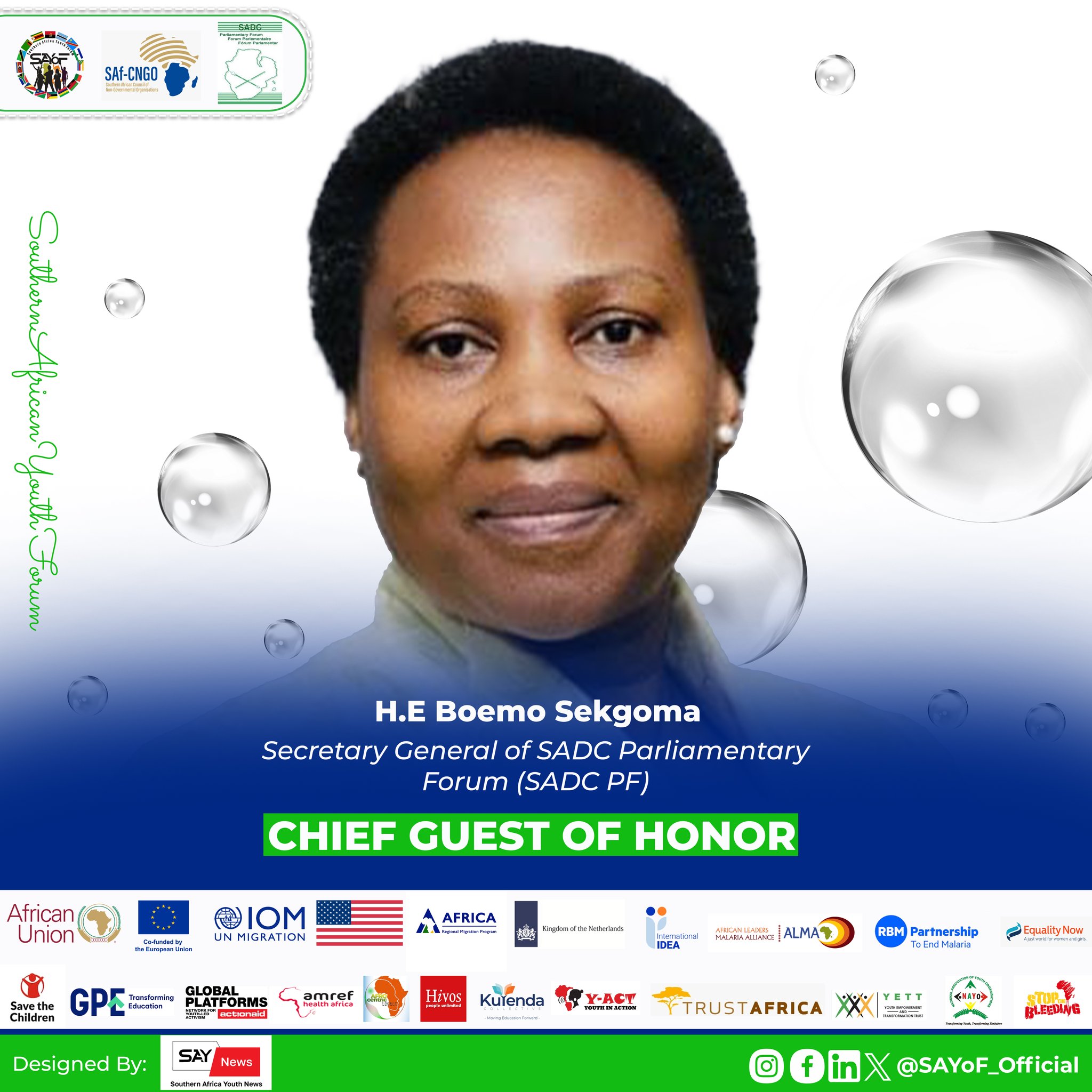
In my capacity as Secretary General of the SADC Parliamentary Forum and Patron of the Southern Africa Youth Forum, I wish to thank you all for your vibrant and stout presence at this august gathering.
Building on the sterling efforts made last year, the Southern Africa Youth Forum continues to be a powerhouse of youth dynamism and proactiveness. This is undoubtedly a sign of optimism for youth in Southern Africa who will be the heralds of economic prowess and prosperity for the region and the continent at large.
This time around as we ponder on the theme: “Empowering the Future: Innovative Education for Sustainable Development in Southern Africa,” we will be contemplating the consolidation of policy and legal frameworks to empower the youth through innovative education, in line with the theme of the African Union for this year.
To truly empower our youth, we must embrace innovative education that is relevant, inclusive, and transformative. Education should not be confined to traditional classrooms but should encompass a holistic approach that nurtures creativity, critical thinking, and problem-solving skills. It should equip young people with the knowledge and tools to address the pressing issues of our time, such as climate change, poverty, and inequality.
We cannot talk about Innovative Education for Sustainable Development in Southern Africa without first ensuring access to education for young people, particularly young women. A recent report by the United Nations Secretary-General, presented on 12 July 2023 and titled “A World of Debt: A Growing Burden to Global Prosperity,” paints quite a grim picture of the growing public debt burden and its impact on the provision of education and health. The report reveals that, on average, African countries pay four times more for borrowing than the United States and eight times more than the wealthiest European economies.
This has precipitated a situation where a total of 52 countries—almost 40 percent of the developing world—are in serious debt trouble.
Currently half of all developing nations spend a minimum of 7.4% of their export revenues on servicing external public debt. The rapid growth of interest payments is surpassing other public expenditures, with some governments being compelled to spend more on servicing debt than on critical sectors like education and health. More disturbingly, the report shows that at least 19 developing nations allocate more money to interest payments than to education, and 45 allocate more to interest payments than to health expenditure.
The disparities in interest rates does not only highlight the inherent inequality in the international financial system but also exposes how this system, which disproportionately burdens developing countries and their capacities to deliver education, cannot be sustained.
Young people must add their voices to the calls for a reformed and fit-for-purpose International Financial Architecture—one that is more inclusive and responsive. This will ensure that developing countries are not only actively involved in the governance of the international financial system but also able to prioritise funding for education and health.
The current skewed financial system contributes to inequalities and vulnerabilities among young people and exacerbates social challenges such as child marriages. Such inequalities and vulnerabilities worsen in crisis situations, as we have seen during COVID-19, in climate-related disasters like droughts and cyclones and in situations of political conflicts.
The youth of today are simultaneously dealing with multiple challenges on different fronts. Hyperinflation, unemployment, inequality, poverty, climate change, lack of adequate housing are concerns which impact negatively on the health and quality of life of the youth.
According to statistics, at least 4 SADC countries have a youth unemployment rate of more than 30%. It is also well known that the major chunk of the unemployment ratio is to be attributed to the youth who are often unskilled and are in transition to settling down into stable employment. The youth also constitute the population segment which is progressively moving out of their family homes and thus in search of adequate housing.
At the same time, over 25% of People Living with HIV in most SADC countries constitute of the youth, and it is also the youth faction, especially women, who suffers disproportionately from gender-based violence.
It is no secret that in Africa, the youth do not participate equitably in entrepreneurship, innovation or in intellectual property.
Education is at the centre of life, and without education, children and the youth cannot gain the requisite skills and competencies to partake in socio-economic development.
Education aims to fully develop human personality and its understanding of human dignity.
In this respect, I must emphasise that the SADC Parliamentary Forum has consistently advocated for comprehensive education to be dispensed to the youth from a rules-based approach in line with the human right to education consecrated under Articles 13 of the International Covenant on Economic, Social and Cultural Rights, and Article 17 of the African Charter for Human and Peoples’ Rights.
Education is to be viewed broadly, and it encapsulates academic, technical, professional as well as life skills education. Education of the youth will also not be complete without comprehensive sexuality education which is age-appropriate, culturally sensitive and which explains the rule-based approach to SRHR.
It thus augurs well for the 6th Youth Forum to include all the different aspects of youth interaction with political and socio-economic life, including partnerships with civil society, the public and private sector, as well as Parliament as an institution. These partnerships undoubtedly have a role to play in improving the education of the youth and in promoting legal and policy frameworks which are responsive to youth education needs and requirements.
I therefore encourage youth present today to actively interface with invited partners and stakeholders to nurture enduring relationships that may assist you to make headway on the enhancement of youth policy at national level. The reform of education systems to reflect youth realities should be prioritised by SADC Governments and Parliaments in line with Conventions and Treaties already signed and ratified.
With this reflection on treaty ratification, the youth are called upon to work with parliamentarians, policymakers and CSOs to accelerate the lobby for domestication of youth policy set out in the African Youth Charter which has been ratified by most SADC Member States.
I would here wish to highlight that Article 13 of the African Youth Charter is a comprehensive legal provision which will without doubt give guidance on skills development and the national education curricula.
For recall, Article 13, subsection 3(f) provides clearly that the education of young people shall be directed to the development of life skills to function effectively in society and include issues such as HIV/AIDS, reproductive health, substance abuse prevention and cultural practices that are harmful to the health of young girls and women as part of the education curricula.
Article 13 of the African Youth Charter also provides that education should include respect for the environment and natural resources, which resonates with climate action and the need to promote a sustainable future for all, with no one left behind.
While the African Youth Charter is but one of the many international instruments which can bolster youth education, it is necessary to ensure that legal provisions at international or regional level are domesticated through a structured approach that involves active youth participation.
There is thus currently a need for the youth to take cognisance and be interested in domestic processes to ensure that domestication of education related treaties is an ongoing activity supported by consistent advocacy initiated by the youth themselves. In so doing, there is further need for the youth to feed information to parliamentarians and policymakers on a permanent basis through working groups and consultative collaborations under the aegis of Parliament.
The SADC Model Law on Public Financial Management is also a key instrument which provides that international commitments including youth provisions should be domesticated and reported upon through the yearly budget, thus heightening accountability.
In the 21st century, it is crucial for the youth to take a concrete part in holding their governments to account on education policy, and this can only materialise through the regular scrutiny of treaty provisions vis a vis national law through an open dialogue with parliamentarians and policy makers.
Public hearings, sensitisation campaigns and other fora where the youth can be heard are to be encouraged in this quest for responsive education policies.
Responsiveness of youth policies needs to tackle the aspirations outlined in regional development agendas such as SADC Vision 2050 and Africa Agenda 2063 which seek to indicate a trajectory where Africans can finally partake in the global economy through innovation, corporate entrepreneurship, and flexible avenues for trade in goods and services which engender wealth creation and economic stability whilst preserving the environment.
I wish to end by seizing this opportunity as Patron to wish you a happy International Youth Day to be celebrated on the 12th of August 2024 under the theme of youth digital pathways for sustainable development. Since digital skills form part of youth education, it is clear that education has a pivotal role to play for technologies to be leveraged for the development of the region.
With the older generation less conversant in new technologies, it is indeed incumbent on the youth to heighten productivity in education and at work through the integration of digital skills.
We must foster partnerships across borders, share best practices, and leverage our diverse strengths to achieve our common goals. Together, we should build a Southern Africa that thrives on innovation, values its cultural heritage, and upholds the principles of justice and equality.
Let us remember that the journey toward sustainable development is not a solitary one. It requires the collective effort of all stakeholders, including governments, civil society, the private sector, and, most importantly, the youth.
With these words, I conclude by expressing confidence that this meeting will be a springboard for fruitful outcomes to be harvested in enhancing youth education policy across all SADC Member States and build a region that is resilient, inclusive and prosperous for generations to come.
I thank you for your kind attention.
Ms B. Sekgoma,
Secretary General of SADC-PF and Patron for Southern Africa Youth Forum
10th August 2024