



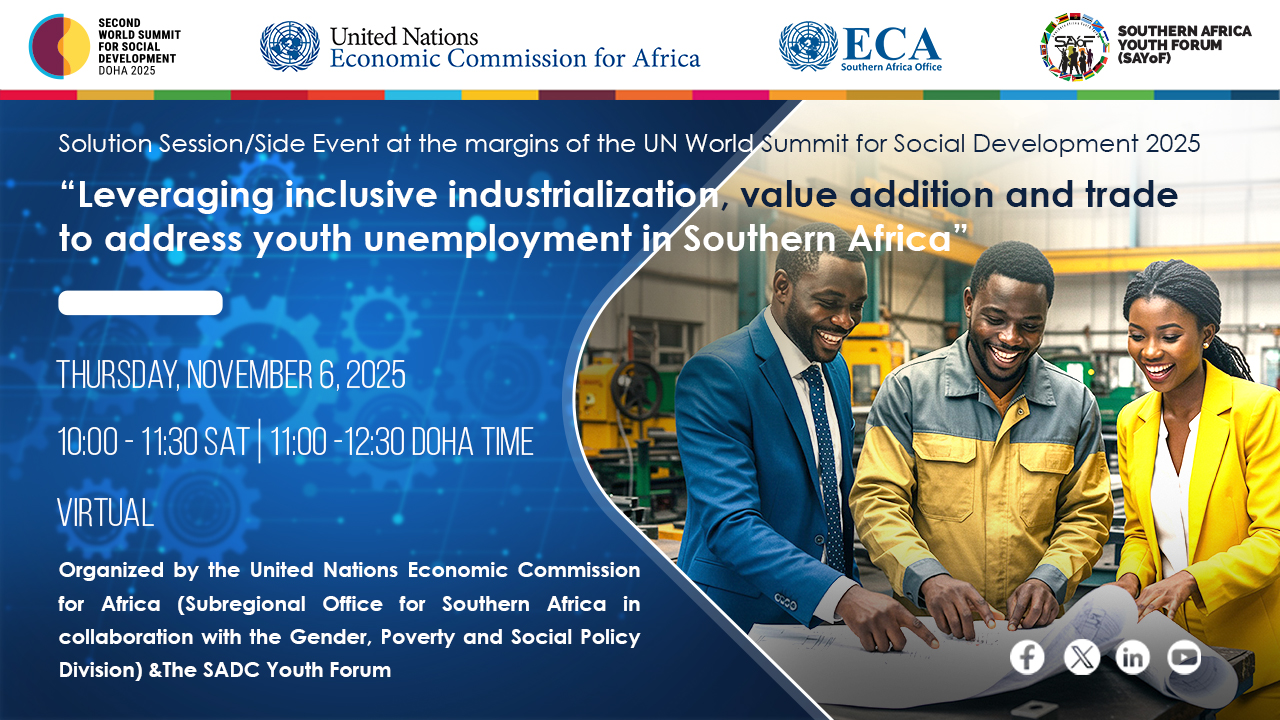
Southern Africa Youth Forum (SAYoF) Presentation | Doha|Second World Summit for Social Development | 06-11-25|
Ladies and gentlemen, esteemed guests, and distinguished participants,
It is a privilege to present before you today at this pivotal event, co-convened by the United Nations Economic Commission for Africa (UN-ECA) and the Southern Africa Youth Forum (SAYoF). This gathering is a vital part of the Second World Summit for Social Development 2025. Together, we are here to address a pressing challenge that affects millions across our region: youth unemployment and how we leverage Inclusive Industrialization, Value Addition, and Trade to address the former.
Southern Africa is at a crossroads. Our youth population is vibrant and innovative, brimming with potential. Yet, many young people struggle to find meaningful employment. Today, we will dive deep into the trends and root causes of this crisis, drawing on our diverse country-specific experiences to understand not just the symptoms but the underlying factors that contribute to it.
The unemployment rates among youth in our region are alarmingly high. Structural factors such as economic disparities, inadequate educational opportunities, and limited access to resources worsen this crisis. As we examine these trends, it is crucial to assess the effectiveness of existing policies, particularly those focused on skills development and youth enterprise support. The question is, “Are we equipping our young people with the necessary skills to thrive in an evolving job market?” Are our policies adequately fostering entrepreneurship and supporting youth-led initiatives?”
As we move forward, we must co-design innovative policy and financial measures that can scale up youth-led enterprises and create jobs. This is especially important for young women, who often face additional barriers in accessing the resources and opportunities they need. We must ensure that all young people have equitable access to these opportunities, recognizing that diversity drives innovation and economic growth. Through our SAYoF Business, Innovation, and Entrepreneurship Cluster, we are trying our level best through collaboration to foster this narrative.
A significant part of our dialogue will focus on bridging the gap between educational institutions and industry. Aligning our skills development strategies—particularly in Technical and Vocational Education and Training (TVET) and STEM—with the needs of emerging manufacturing sectors is crucial. If we foster partnerships between educational institutions and industry, we can create pathways for our youth that are not only relevant but also sustainable.
Additionally, we have a unique opportunity with the African Continental Free Trade Area (AfCFTA) to leverage regional value chain development and resource beneficiation. We can harness these frameworks, and we can create sustainable employment opportunities, particularly for youth-led small and medium enterprises. Exploring how these initiatives can support job creation and entrepreneurship in our communities is essential.
There is a need to share innovations and best practices from across the region. Learning from one another will help us foster entrepreneurship, enhance job creation, and encourage youth participation in trade and industry. This exchange of ideas is crucial for developing a robust ecosystem that supports our young people.
Ultimately, our discussions aim to produce practical recommendations that will help leverage national and regional industrial strategies for youth enterprise development and job creation. We need to forge stronger links between industrial planners, financiers, and young innovators to ensure that our youth are integrated into the economic fabric of our region.
As we engage in these discussions, let us remember the critical importance of innovative financing mechanisms and policies that support youth-led entrepreneurship. Aligning skills development with the evolving demands of industry and trade is vital. Together, we can deepen the conversation on new partnership models between the public sector, private industry, and financial institutions, paving the way for a brighter future for our youth.
In closing, I urge each of you to contribute your insights and experiences as we work towards a shared understanding of the drivers of youth unemployment in Southern Africa. Together, we can formulate actionable strategies that not only address this pressing issue but also empower our young people to lead the way in shaping our economic future. As SAYoF, we are eager to collaborate to empower the youth in our beloved Southern Africa region!
Thank you.