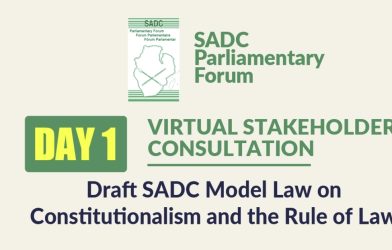




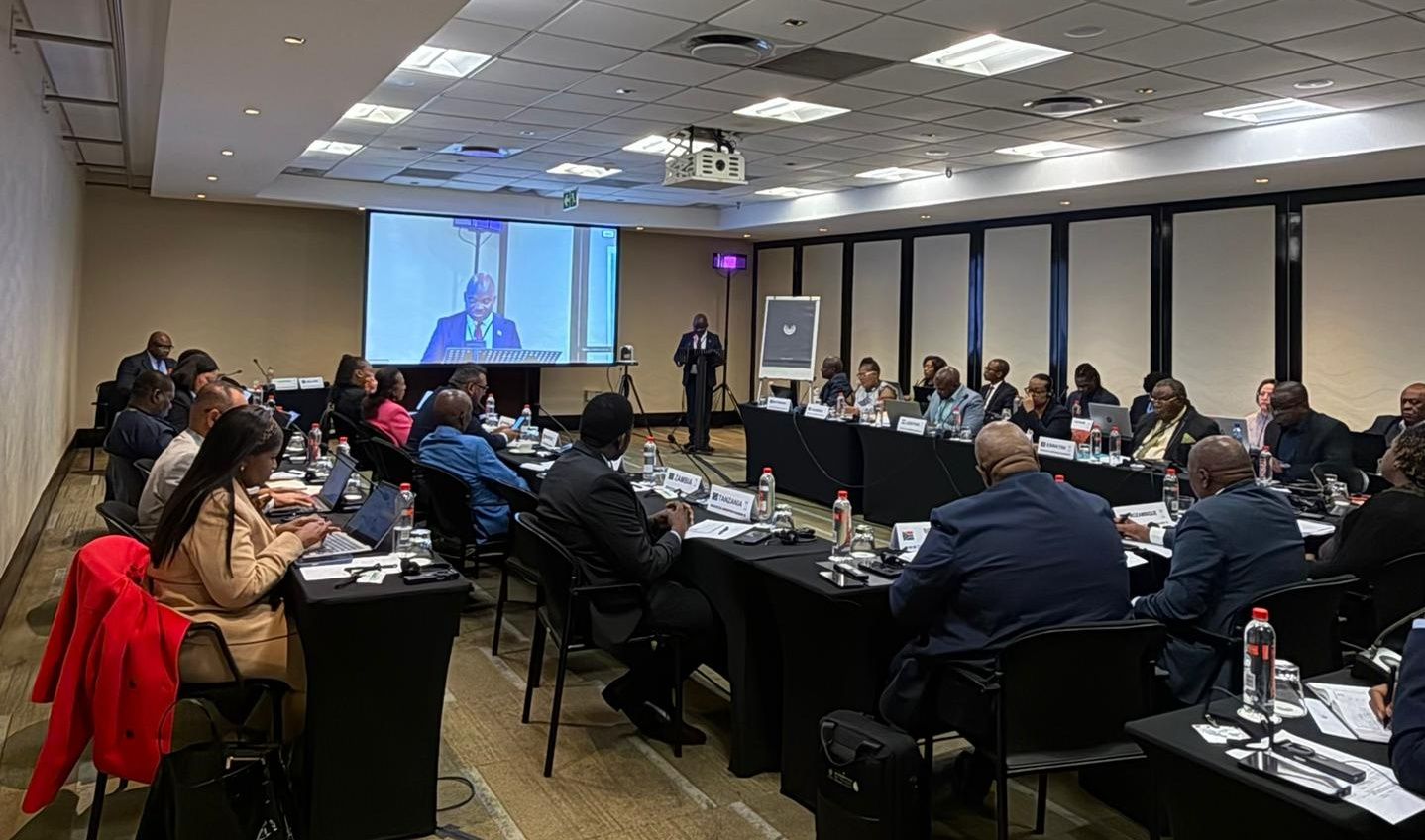
REMARKS BY THE CHAIRPERSON OF THE STANDING COMMITTEE ON DEMOCRATISATION, GOVERNANCE AND HUMAN RIGHTS (DGHR) HON PETER DIMBA DURING THE STAKEHOLDERS’ CONSULTATION ON THE DEVELOPMENT OF THE SADC MODEL LAW ON CONSTITUTIONALISM AND THE RULE OF LAW 22–23 APRIL 2026, SOUTHERN SUN, JOHANNESBURG, SOUTH AFRICA
SALUTATIONS
It is both an honour and a privilege to address this distinguished gathering as Chairperson of the SADC PF Standing Committee on Democratisation, Governance and Human Rights (DGHR).
The Standing Committee occupies a central place in the work of the SADC Parliamentary Forum. It is entrusted with advancing the core values that sustain democratic societies: constitutionalism, respect for the rule of law, protection of human rights, and strengthening accountable institutions. These are not abstract ideals, but practical foundations for peace, stability, sustainable development, and public confidence in democratic governance.
Consistent with this responsibility, our mandate is both clear and far-reaching. Rule 42(d) of the SADC PF Rules of Procedure entrusts the Committee with oversight of matters relating to politics, security, and governance; the promotion of parliamentary democracy; the advancement of constitutionalism; the strengthening of electoral institutions; the harmonisation and domestication of SADC legal instruments; and the fostering of broad-based citizen participation in democratic governance processes.
Your Excellencies and Honourable Members,
In fulfilling this mandate, the DGHR Committee has, over time, provided leadership in the development of normative frameworks that have progressively shaped democratic practice in the SADC region. Beginning with the Norms and Standards for Elections in the SADC Region (2001) — the first regional election instrument of its kind in SADC and indeed on the African continent — the Committee laid an early foundation for common democratic principles across Member States. This work was further deepened through the Benchmarks for Democratic Legislatures in Southern Africa (2010) and its accompanying Self-Assessment Toolkit (2012), which strengthened institutional capacity by enabling parliaments to evaluate and improve their performance against agreed democratic standards.
Building on this trajectory, the Committee advanced the Benchmarks for Assessing Democratic Elections in the SADC Region (2013), a comprehensive compendium of electoral obligations derived from SADC, African Union and United Nations instruments, which provides practical criteria for assessing the credibility, integrity and transparency of electoral processes within SADC Member States. The progression culminated in the adoption of the SADC Model Law on Elections (2018), a comprehensive legislative reference that continues to guide electoral reform, strengthen electoral institutions, and support the conduct of credible, transparent and inclusive elections across the region. Most recently, the Committee guided the development of the Principles and Guidelines for Parliaments in Promoting Human Rights (2023), reinforcing the central role of parliaments in safeguarding fundamental freedoms and ensuring accountability in governance.
Your Excellencies and Honourable Members,
All these instruments were duly approved by the Plenary Assembly, reflecting the collective will of Member Parliaments to promote democratic governance through shared standards and mutually reinforcing institutional frameworks. Taken together, they demonstrate the Committee’s sustained commitment to strengthening democratic institutions, enhancing electoral integrity, promoting human rights, and supporting the development of accountable governance systems across the region.
Against this background, the development of the SADC Model Law on Constitutionalism and the Rule of Law represents a natural and logical progression in the Committee’s normative work. While the Model Law on Elections focuses on the integrity of electoral processes as a cornerstone of democracy, the present initiative broadens the scope to address the wider constitutional architecture that sustains democratic systems. It recognises that credible elections must be supported by strong constitutional frameworks, effective separation of powers, independent institutions, and a culture of legality anchored in the rule of law.
In this regard, it is important to recall that, at its 49th Plenary Assembly Session held from 25 to 27 June 2021, the Plenary mandated the DGHR Standing Committee to spearhead the development of the SADC Model Law on Constitutionalism and the Rule of Law, in accordance with the Forum’s established procedure for developing normative instruments. This mandate entrusted the Committee with providing strategic direction, technical oversight, and stakeholder coordination throughout the drafting process. The present consultation therefore forms an integral step in an inclusive and structured process approved by the Plenary Assembly, reinforcing the legitimacy, ownership, and institutional authority of the Model Law.
The development of the SADC Model Law on Constitutionalism and the Rule of Law is firmly anchored in the foundational provisions of the SADC Treaty. Article 4(c) affirms that SADC and its Member States shall act in accordance with the principles of human rights, democracy and the rule of law, while Article 5(1)(b) commits the Community to promote common political values and systems through institutions that are democratic, legitimate and effective. Article 5(1)(c) further underscores the collective responsibility to consolidate, defend and maintain democracy, peace, security and stability, and Article 23 emphasises the importance of the full participation of the people of the Region and key stakeholders in advancing the Community’s shared governance agenda. Taken together, these provisions provide both the legal foundation and normative impetus for the present Model Law, which seeks to translate Treaty commitments into practical legislative guidance that strengthens constitutional governance, reinforces the separation of powers, safeguards fundamental rights, and enhances the accountability of public institutions across the SADC region.
Your Excellencies and Honourable Members,
Constitutionalism is the anchor of democratic legitimacy. It ensures that public authority is exercised within agreed limits, that institutions operate within clearly defined mandates, and that citizens enjoy protection of their rights under the law. The rule of law assures that power is exercised predictably, transparently, and in a manner consistent with justice.
In our region, the consolidation of constitutional democracy remains an ongoing project. While SADC Member States have made commendable progress in strengthening democratic institutions, evolving governance challenges continue to require deliberate and coordinated responses. These challenges include maintaining institutional balance among branches of government, safeguarding judicial independence, strengthening oversight institutions, promoting constitutional compliance, and ensuring meaningful citizen participation in governance processes.
The work before us responds directly to these priorities. The proposed Model Law seeks to support Member States in promoting constitutional supremacy, strengthening separation of powers, reinforcing accountability mechanisms, and ensuring respect for fundamental rights. It also seeks to enhance coherence between national legal systems and regional governance standards reflected in instruments such as the SADC Treaty and the African Charter on Democracy, Elections and Governance.
Your Excellencies and Honourable Members,
The DGHR Committee recognises that effective constitutional governance depends not only on the quality of legal provisions, but also on the strength of institutions responsible for implementation. Parliaments play a particularly critical role in this regard. Through legislation, oversight, representation, and public engagement, Parliaments serve as guardians of constitutional order and promoters of democratic accountability.
It is for this reason that the DGHR Committee has consistently prioritised initiatives that strengthen electoral integrity, promote inclusive governance, enhance oversight capacity, and deepen citizen participation. The Model Law on Constitutionalism and the Rule of Law complements the Committee’s ongoing efforts to support the development of democratic norms and standards across the region.
Equally important is the consultative methodology adopted for this process. The legitimacy of any normative instrument is strengthened when it reflects diverse perspectives and practical experience. The participation of jurists, electoral bodies, constitutional experts, civil society organisations, academia, youth representatives, and other stakeholders who are here ensures that the Model Law is both technically sound and responsive to the realities of our Member States.
Your Excellencies and Honourable Members,
As Chairperson of the DGHR Committee, I wish to emphasise that the Committee views this consultation not merely as a procedural step, but as a substantive opportunity to shape a robust and forward-looking normative framework capable of responding to contemporary governance challenges. We look forward to receiving practical insights on how constitutional safeguards can be strengthened, how institutional accountability can be enhanced, and how democratic resilience can be reinforced in the face of emerging pressures.
Particular attention must be paid to ensuring that constitutional frameworks remain responsive to evolving governance realities, including stronger coordination among institutions, improved mechanisms to prevent constitutional crises, and enhanced protection of fundamental rights.
The Committee will continue to provide technical oversight throughout the drafting process, working closely with the Technical Working Group, legal drafters, and stakeholders to ensure coherence, legal clarity, and alignment with regional standards. Ultimately, the Model Law will be submitted to the Plenary Assembly for consideration and adoption as an instrument that supports Member States in strengthening democratic governance.
Your Excellencies and Honourable Members,
Allow me to conclude by reaffirming the DGHR Committee’s commitment to advancing constitutionalism, promoting democratic governance, and strengthening institutions that uphold the rule of law across the SADC region.
I encourage all participants to engage actively in the discussions, to share insights drawn from national experience, and to contribute constructively to shaping a Model Law that reflects both our regional aspirations and our collective responsibility to future generations.
I thank you.