



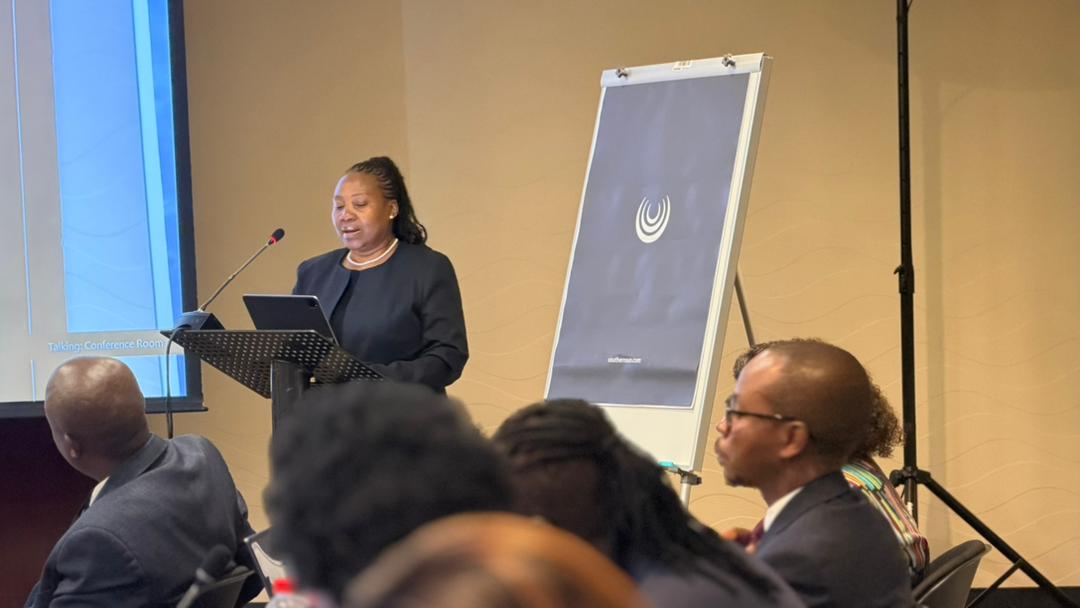
INTRODUCTORY REMARKS BY THE SECRETARY GENERAL, SADC PARLIAMENTARY FORUM STAKEHOLDERS’ CONSULTATIVE MEETING ON THE DEVELOPMENT OF THE SADC MODEL LAW ON CONSTITUTIONALISM AND THE RULE OF LAW
22–23 APRIL 2026
JOHANNESBURG, SOUTH AFRICA
SALUTATIONS
Chairperson of the Standing Committee on Democratization, Governance and Human Rights, Hon Peter Dimba
Vice Chairperson of the Democracy, Governance and Human Rights Committee, Hon. Sophie Ratsiraka
Members of the Standing Committee on Democracy, Governance, and Human Rights
The Legal Drafter for the SADC Model Law on Constitutionalism and Rules of Law, Professor Dr Oagile Key Dingake
Resources Person, Dr Justice Alfred Mavedzenge, Head of Research, Democratic Governance and Rights Unit, Faculty of Law, University of Cape Town, and Chairperson of the Commission of Inquiry for the Prison Riot Commission in Seychelles.
GIZ Representative Dr Adane Ghebremeskel, Component Manager Strengthening National-Regional Linkages in SADC (SNRL) Programme
Our Distinguished Partners and those online
SADC PF and Parliament officials
Distinguished Participants, Ladies and Gentlemen,
Allow me, on behalf of the SADC Parliamentary Forum, to express our sincere appreciation for your presence here today and for the privilege of delivering these opening remarks at this important consultative meeting.
At the outset, I wish to pay tribute to our valued collaborators and partners — including International Partnerships Austria, the German Cooperation, GIZ, ECF, international IDEA, SAYoF, UNWomen, Thabo Mbeki School of Governance — who are represented among us in significant numbers. Your steadfast engagement in the development of the Model Law on Constitutionalism and the Rule of Law is both timely and deeply appreciated. Your participation over the next two days will enrich our deliberations and strengthen the foundation upon which this landmark legal instrument will be built.
Over the years, the SADC Parliamentary Forum has developed the Bill of Rights- a distinguished body of Model Laws that collectively reflect a regional commitment to advancing human dignity, justice, and accountable governance. These include Model Laws addressing HIV and AIDS, the eradication of child marriage and the protection of children already in marriage, elections, gender-based violence, and, more recently, Public Financial Management. In the near future, the Forum will also adopt a Model Law on Prison Oversight, currently under development, at its 59th Plenary Assembly in Seychelles.
However, as our work evolved, the Forum’s Standing Committees have come to a profound realisation that while these Model Laws address diverse themes, they are all anchored on one unique aspect, which constitutes the bedrock of compliance with legal norms, which is the Rule of Law.
Without the Rule of Law, no legal framework can endure, and no democratic order can sustain legitimacy. The Rule of Law is the golden thread that gives laws their authority as binding norms; norms that apply universally, equally to all persons, institutions, and nations, without exception.
Today, we are witnessing developments, both at national and international levels, where legal provisions are sometimes disregarded or selectively applied. In such circumstances, the danger is clear: power may prevail over principle, and strength over justice. The Rule of Law exists precisely to guard against this outcome.
It is, at its core, a guarantee of equality and non-discrimination. It ensures that disputes are resolved through lawful processes rather than through violence or coercion. It affirms that laws enacted by Parliament, whether domestic statutes or international obligations, must be respected, implemented, and enforced by competent authorities.
Equally, the Rule of Law demands accountability. Where laws are violated, consequences must follow, whether in the form of civil remedies, criminal sanctions, administrative penalties, or public censure. It further requires that judicial decisions be respected and enforced, for the authority of the courts is indispensable to the maintenance of legal order.
If violations of the law go unpunished, public confidence in the legal system begins to erode. Citizens may cease to believe in the fairness or effectiveness of the law, thereby threatening the very fabric of social order. History reminds us that, in the absence of lawful authority, societies risk descending into a state of disorder governed by force rather than reason, a condition memorably described by the philosopher Thomas Hobbes as life that becomes “solitary, poor, nasty, brutish, and short.”
The Rule of Law therefore, requires the existence of competent institutions capable of enforcing legal norms. Independent and impartial courts must be empowered to adjudicate disputes. Law enforcement agencies must act within the bounds of legality. Correctional and civil enforcement systems must ensure that legal consequences are applied consistently and fairly. At the international level, adherence to treaties and conventions must likewise be supported by credible mechanisms of accountability.
Allow me to note, however, that the Rule of Law is not synonymous with the Rule of Justice. A law may be legally valid even when it appears, in particular circumstances, to fall short of popular notions of fairness. For example, the lawful exercise of executive clemency may not always satisfy public expectations of justice. Nevertheless, the legitimacy of the legal system depends on the consistent application of established rules.
Most laws strive to approximate justice as closely as possible, even though perfection may remain elusive. This tension between law and justice has long been acknowledged by jurisprudential thinkers such as Jeremy Bentham and John Austin, who emphasised the importance of positive law as the foundation of social order.
Ultimately, the responsibility to enact laws rests with Parliament — the institution that embodies the will of the people. Citizens look to Parliament as the guardian of justice, stability, and democratic governance. The Model Law on the Rule of Law will therefore engage closely with the notions of justice, while recognising that the rule of law must not be plied in the face of abstract notions of justice.
Indeed, when perceptions of justice become detached from lawful processes, the risk of instability increases. Civil unrest, institutional breakdown, and even unconstitutional changes of government often arise in contexts where legal systems fail to address abuses of power or protect democratic institutions. Strong institutions are therefore essential to sustaining peace and stability.
In this regard, the proposed Model Law seeks to strengthen the resilience of democratic institutions — particularly Parliaments and judiciaries — so that they remain functional even in times of crisis. It will promote lawful mechanisms for resolving disputes, ensuring that conflicts are addressed through established procedures rather than through force.
Distinguished Participants, Ladies and Gentlemen,
You will have noted that this initiative is framed not only as a Model Law on the Rule of Law, but also as a Model Law on Constitutionalism.
It is often said that the pinnacle of the Rule of Law is a strong and respected Constitution. Constitutionalism means that the exercise of public power — including the power of Parliament itself — must conform to constitutional principles and procedures. The Constitution stands as the supreme law of the land, the grundnorm, or basic norm, in the terminology of the jurist Hans Kelsen.
Any law that is inconsistent with the Constitution is, to the extent of that inconsistency, null and void. Constitutionalism therefore provides a system of checks and balances that ensures the lawful exercise of authority. Constitutional courts or equivalent institutions serve as guardians of the constitutional order, ensuring that legislation and executive actions remain within legal bounds.
The Model Law we are developing is thus intended to address gaps and vulnerabilities within democratic systems by reinforcing the fundamental values that enable nations to thrive under constitutional governance.
Distinguished Participants, Ladies and Gentlemen,
Allow me now to turn briefly to the procedural aspects of the Model Law-making process.
This will be the seventh Model Law developed by the SADC Parliamentary Forum. Over time, the Forum has accumulated considerable experience and institutional wisdom in the development of such instruments.
The process begins with the consultative phase — the stage at which we currently find ourselves. This phase will culminate in the preparation of a Policy Paper that will be presented to stakeholders and Members of Parliament in order to build consensus and ensure inclusiveness.
Thereafter, the drafting phase will commence under the guidance of a Technical Committee of Experts, which will provide continuous oversight to ensure legal precision, coherence, and alignment with regional standards.
Once the initial draft has been prepared, it will be subjected to extensive consultations across the SADC region. These consultations will involve representatives of all three branches of the State — the Judiciary, the Legislature, and the Executive — as well as legal practitioners, prosecutors, magistrates, judges, law enforcement officers, government officials, human rights institutions, and civil society organisations.
This inclusive consultation process is the linchpin of regional ownership and legitimacy. It ensures that the Model Law reflects the collective wisdom of the region and addresses the practical realities faced by Member States.
Following these consultations, the final draft will be recommended by the relevant Standing Committee to the Joint Committee structure and ultimately to the Plenary Assembly of the Forum for adoption.
Adoption by the Plenary Assembly — composed of elected Members of Parliament from across the region — confers democratic legitimacy upon the Model Law. Once adopted, the instrument will function as soft law: a persuasive legal framework that guides national legislation while allowing each Member State to domesticate its provisions in accordance with its constitutional processes.
Distinguished Participants, Ladies and Gentlemen,
This consultative meeting represents a critical milestone in the journey toward the finalisation of the Policy Paper. The group discussions over the next two days will shape the substance of the Model Law by identifying priority areas and key principles relevant to the SADC region.
You are therefore encouraged to participate actively, openly, and constructively in these deliberations.
Your insights and expertise will help ensure that the Model Law is inclusive, responsive, and firmly grounded in the democratic aspirations of the people of Southern Africa.
In many respects, you are here to make history — to contribute to the development of a legal framework that will strengthen democratic governance and safeguard the rights and freedoms of more than 400 million citizens across the SADC region.
The principles of constitutionalism and the Rule of Law concern us all, regardless of nationality, profession, or background. They define the standards by which societies are governed and the mechanisms through which justice is pursued.
I therefore invite you to approach this task with determination, vision, and a shared commitment to the future of our region.
With these words, I thank you for your kind attention and wish you productive deliberations.
Yours sincerely,
Ms B. Sekgoma
Secretary General
SADC Parliamentary Forum