


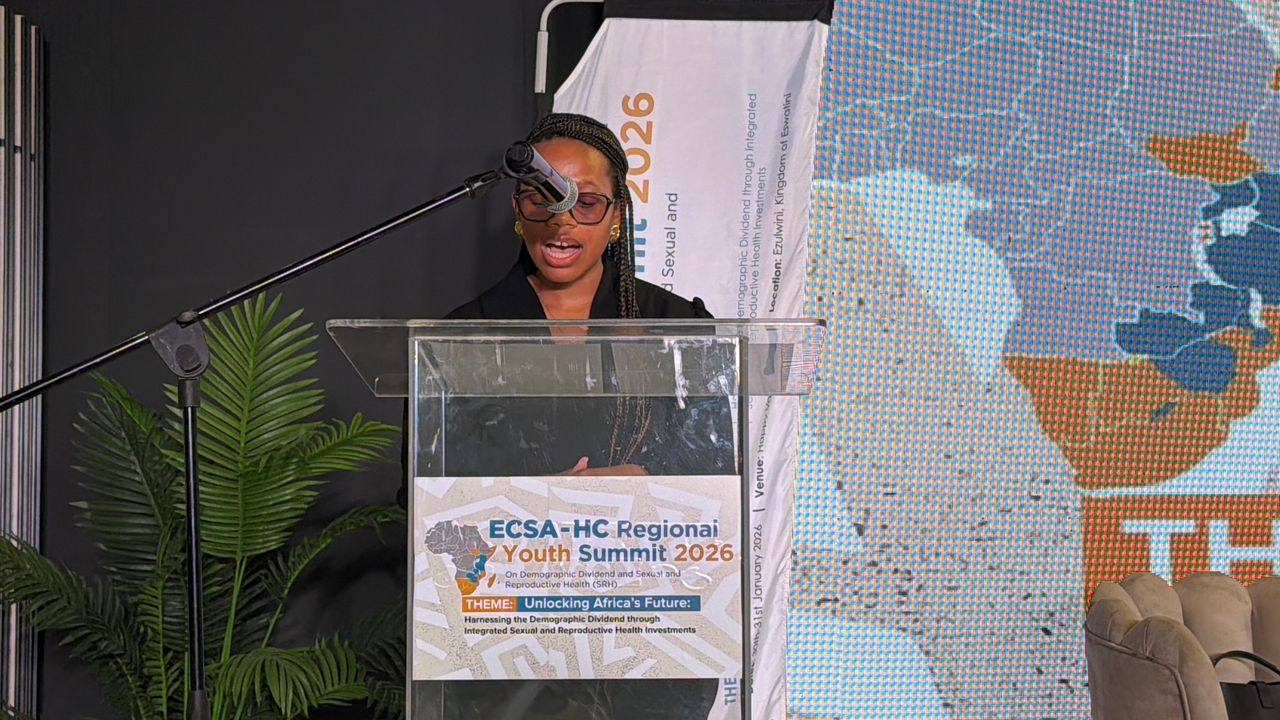
Southern Africa Youth Forum (SAYoF) Key Note Remarks on the Regional Summit on Sexual and Reproductive Health and the Demographic Dividend: delivered by the Right Honourable Thembela Msibi, Member of the SAYoF Regional Board, 30 January 2026, Mbabane, Kingdom of Eswatini.
SALUTATIONS
On behalf of the Southern Africa Youth Forum (SAYoF), we are humbled to speak and stand before you today to discuss a matter profoundly critical to our future: the sexual and reproductive health of young people in East and Southern Africa. Our presence at this Regional Youth Summit on Sexual and Reproductive Health and the Demographic Dividend, hosted by the East, Central, and Southern Africa Health Community (ECSA-HC), with the support of the African Union Development Agency (AUDA-NEPAD), and the Government of Eswatini, is a testament to great progress and recognition that more needs to be done.
Ladies and Gentlemen, the theme of the Summit: “Unlocking Africa’s Future: Harnessing the Demographic Dividend through Integrated Sexual and Reproductive Health Investments,” resonates greatly with the Regional Indicative Strategic Development Plan (RISDP), SADC SRHR Strategy 2019-2030, SADC Model Law on HIV, and the SADC Model Law on Gender Based Violence.
In Africa, we are proud of the cultural richness and dynamism of our youth, but we also recognize the challenges they face. The barriers to accessing SRH services create risks that can impair their potential. Adolescents and young people in East, Central, and Southern Africa face significant legal, cultural, and systemic barriers to accessing sexual and reproductive health and rights (SRHR) services. Age-of-consent laws, parental consent requirements, stigma, and misconceptions within service delivery environments continue to prevent youth from exercising their rights to health and bodily autonomy. The consequences are severe: high HIV incidence, increased teenage pregnancies, unsafe abortions contributing to maternal deaths, school dropouts, and long-term poverty cycles. These challenges continue to undermine progress towards the ESA Ministerial Commitments, the SADC SRHR Strategy 2019-2030, the Maputo Protocol, SDG 3 (Good Health and Well-being), SDG 5 (Gender Equality), and Universal Health Coverage. While national and regional commitments to adolescent SRHR exist, their implementation and alignment with young people’s realities remain inconsistent.
SAYoF has been working with various organisations, regional bodies, and governments to improve access to quality SRHR services and care. Together with HIVOS Southern Africa, we launched the initiative ACCELERATING ACCESS TO SRHR FOR ALL AGES IN THE SADC REGION, anchored on the broader campaign dubbed #Consent2Access to advocate for improved laws, policies, and practices on the age of consent for adolescent access to SRHR information and services in East and Southern Africa. Under this initiative, we are also partnering with the SADC Parliamentary Forum (SADC-PF) to secure high-level political commitment from parliamentarians to champion SRHR reforms and access, equip parliamentarians, and establish an internal cohort of SRHR champions across the SADC region. In 2025, we managed to capacitate more than 70 Members of Parliament from the SADC region during the SADC-PF Standing Committee Meetings in South Africa.
We are working with the SADC Secretariat to advance SRHR Policies in the region. The initiative sought to enhance regional capacities and engage men and boys to Combat Gender-Based Violence, HIV, and advance sexual and Reproductive Health and Rights (SRHR).
SAYoF has an MOU with SADC-PF. We bring the youth voices into policy spaces, and we are looking forward to taking up the resolution of this Regional Youth Summit and present them in the 59th SADC-PF Plenary Assembly. We also sit in various Standing Committees of SADC-PF, including one that oversees SRHR.
Ladies and Gentlemen, the SADC Youth Parliament that we host has a Standing Committee on Health and Sexual Reproductive Rights. Before our annual forum and the Heads of States meeting, the Committee will conduct public hearings, an opportunity for young people to voice their concerns on SRHR and policy issues.
The annual SADC Youth Forum that we co-host with the African Union, SADC-PF, SAF-CNGO, among other has been providing platforms for youth and partners to deliberate and take action on SRHR, notably the participation of UN-IOM, Save the Children, and WOSSO, and bringing marginalized voices on SRHR issues. We continue to unveil ourselves to allow youth inclusion across SADC, and we honour the organisers for their spirited effort to advance the interests of the youth in East, Central, and Southern Africa.
I invite all stakeholders—policymakers, educators, healthcare providers, and community leaders—to join in this mission. Together, we can break down barriers, advocate for comprehensive policies, and ensure that our young people are not just surviving, but thriving.
Let me conclude by saying that quality Sexual Reproductive Health services are essential for the well-being of young people. It is not just about avoiding disease or unplanned pregnancies; it is about ground-up empowerment. Access to SRH services enables youth to make informed choices, pursue educational opportunities, and foster healthy relationships
Thank you for your attention and support as we work towards a healthier future for Africa’s youth. Let’s make sure we stand by the youth for a brighter today and tomorrow.
Thank you!