



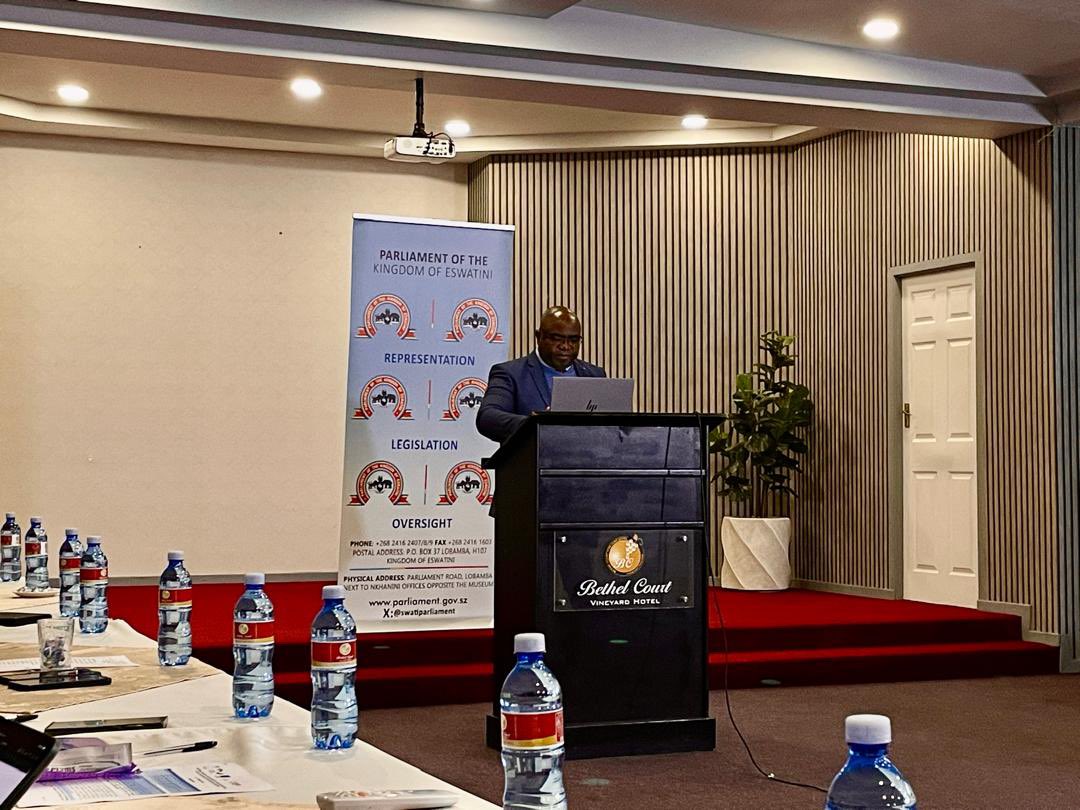
REMARKS BY THE SECRETARY GENERAL OF THE SADC PARLIAMENTARY FORUM, MS BOEMO M. SEKGOMA, DURING THE NATIONAL DOMESTICATION ENGAGEMENT ON THE SADC PROTOCOL AGAINST CORRUPTION IN THE KINGDOM OF ESWATINI, 12–13 AUGUST 2026, PRESENTED ON HER BEHALF BY THE DIRECTOR OF PARLIAMENTARY BUSINESS AND PROGRAMMES, MR SHEUNENI KURASHA
- PROGRAMME DIRECTOR;
- HONOURABLE SPEAKER OF THE HOUSE OF ASSEMBLY OF THE KINGDOM OF ESWATINI, RT. HON. JABULANI CLEMENT MABUZA,
- THE SENATE PRESIDENT, PASTOR LINDIWE DLAMINI;
- SECRETARY GENERAL OF THE SADC PARLIAMENTARY FORUM;
- THEIR LORDSHIPS, THE JUDGES OF THE SUPERIOR COURTS;
- HONOURABLE SENATORS AND MEMBERS OF PARLIAMENT;
- REPRESENTATIVES OF THE SADC SECRETARIAT AND SADC PARLIAMENTARY FORUM;
- REPRESENTATIVES OF THE ANTI-CORRUPTION COMMISSION;
- REPRESENTATIVES OF THE DIRECTOR OF PUBLIC PROSECUTIONS;
- REPRESENTATIVES OF THE ROYAL ESWATINI POLICE SERVICE;
- THE AUDITOR GENERAL;
- REPRESENTATIVES OF GOVERNMENT MINISTRIES AND DEPARTMENTS;
- REPRESENTATIVES OF CIVIL SOCIETY, ACADEMIA, THE MEDIA AND THE PRIVATE SECTOR;
- DISTINGUISHED DELEGATES;
- LADIES AND GENTLEMEN.
It is my honour to address this August gathering on behalf of the Secretary General of the SADC Parliamentary Forum, H.E. Boemo M. Sekgoma, and to convey her warm greetings and sincere appreciation to the Parliament of the Kingdom of Eswatini for co-hosting this important engagement on the domestication of the SADC Protocol Against Corruption.
This partnership is anchored in a long and distinguished history. The Parliament of Eswatini is a founding Member of the SADC PF and has remained an active and steadfast participant in the work of the Forum. Its Members continue to serve in various capacities within SADC PF organs, with the Honourable Speaker, Rt. Hon. Jabulani Clement Mabuza, having served on the Executive Committee on several occasions. We are therefore particularly pleased that Eswatini will once again demonstrate its commitment to regional parliamentary cooperation as the proud host of the 60th Plenary Assembly in November 2026.
Allow me to anchor my remarks on two propositions.
First, corruption is a parliamentary issue.
Second, regional commitments mean little to our citizens unless they are translated into national laws, institutions, budgets and action—and Parliament is central to that process.
Corruption is often treated primarily as a matter for anti-corruption commissions, the police, prosecutors and the courts. These institutions are indispensable. But corruption is also fundamentally about governance, public resources and development.
It is therefore Parliament’s business.
Parliament makes laws. Parliament approves budgets and authorises public expenditure. Parliament scrutinises government spending and procurement. Parliament receives reports from Auditors-General and other accountability institutions. And Parliament represents the citizens who ultimately bear the cost when public resources are misused.
The scale of that cost is enormous. According to the United Nations, illicit financial flows cost Africa an estimated US$88.6 billion every year, equivalent to about 3.7 per cent of the continent’s GDP.
Think about what that represents: schools that could be built, hospitals that could be equipped, water systems that could be expanded, investments that could be made in agriculture and climate resilience, and opportunities that could be created for our young people.
The consequences of corruption extend far beyond financial loss. It deprives our people of development opportunities, weakens institutions, deepens inequality, undermines gender equality and erodes citizens’ trust in government. These consequences are often felt most acutely by the most vulnerable members of society, whose access to essential services, economic opportunities and justice is disproportionately affected.
That is why Parliament cannot be a spectator in the fight against corruption.
Rt. Hon Speaker, Madam President and Distinguished Participants,
My second point concerns domestication.
SADC has developed an extensive body of Protocols and other regional instruments reflecting our shared aspirations. But signing or ratifying a Protocol is not the end of the journey. It is only the beginning.
A regional Protocol cannot, on its own, protect whistleblowers, strengthen procurement systems, recover stolen assets, compel accountability for public expenditure, or finance an oversight institution. These outcomes are achieved through national laws, national institutions, national budgets and national accountability mechanisms. That is what domestication is ultimately about.
This is where Parliament becomes indispensable. It is the bridge between regional commitments and national implementation. Without that bridge, regional integration risks remaining an agreement on paper rather than a reality in the everyday lives of our citizens.
SADC PF, whose transformation into the SADC Parliament is now at an advanced stage, has placed the domestication of regional instruments at the centre of its work. Accordingly, the Forum has taken a policy decision to intensify efforts over the next two years to promote the signing, ratification and domestication of SADC Protocols and other regional instruments across Member States.
This is critical because the true measure of regional integration is not the number of Protocols we sign, but how effectively those Protocols improve our citizens’ lives.
Rt. Hon Speaker, Madam President and Distinguished Participants,
In 2022, the SADC PF developed the Principles and Guidelines for Parliaments on Curbing Corruption in the SADC Region to strengthen the role of Parliaments in this effort. The Guidelines are intended to drive parliamentary action. They call on Parliament to confront some important questions:
Are our laws fully aligned with the SADC Protocol? Are anti-corruption and oversight institutions adequately empowered and resourced? Are the Auditor-General’s findings acted upon? Are procurement systems sufficiently transparent? Are whistleblowers adequately protected? Importantly, when Parliament identifies weaknesses, does its oversight lead to corrective action? This matters because effective parliamentary oversight must go beyond asking questions; it must result in accountability, corrective action and institutional reform.
Rt. Hon Speaker, Madam President and Distinguished Participants,
It is critical that, at the end of these two days, this meeting should produce a clear assessment of Eswatini’s implementation of the SADC Protocol Against Corruption, record the successes achieved and good practices that may be emulated by other SADC Member States, document the remaining gaps, and, most importantly, make recommendations for action and agree on the course of action—what needs to be done, by whom and within what timeframe.
The diversity of institutions represented here gives us confidence that this is achievable. Fighting corruption is a shared responsibility, with Parliament playing a central role in translating the voices of citizens and stakeholders into effective laws, policies, budgets and accountability.
The fight against corruption will not be won by declarations alone. It will be won when regional commitments translate into national action, public resources are effectively scrutinised, wrongdoing is punished, and citizens can trust that public resources serve their intended purpose.
The Protocol sets out the regional standards and commitment; domestication gives it national effect; and Parliament provides the democratic legitimacy, resources and accountability to translate it into action. Let these two days mark a decisive step from regional commitment to national action, from Protocol to practice, and from promise to measurable results for the people of Eswatini. We must leave here not only with shared commitments, but also with clear actions, responsibilities and timelines that lead to stronger institutions, greater accountability and renewed public trust.
As I conclude, allow me to express our sincere appreciation to the SADC Secretariat for its technical partnership, and to GIZ, International Partnerships Austria, BMZ — German Federal Ministry for Economic Cooperation and Development and the European Union for their financial and technical support. This partnership is critical to advancing domestication and translating regional commitments into national action.
I thank you.
Siyabonga