



“Youth, small businesses and regional partners call for practical, systemic solutions to turn continental trade commitments into real opportunities for young farmers and entrepreneurs”
A regional webinar co-hosted by the Southern African Development Community (SADC), the Southern Africa Youth Forum (SAYoF), the Alliance for a Green Revolution in Africa (AGRA) and the Food and Agriculture Organization of the United Nations (FAO) has called for urgent, coordinated action to prepare the region’s agricultural sector, and particularly its young people and small businesses, to benefit from the African Continental Free Trade Area (AfCFTA).
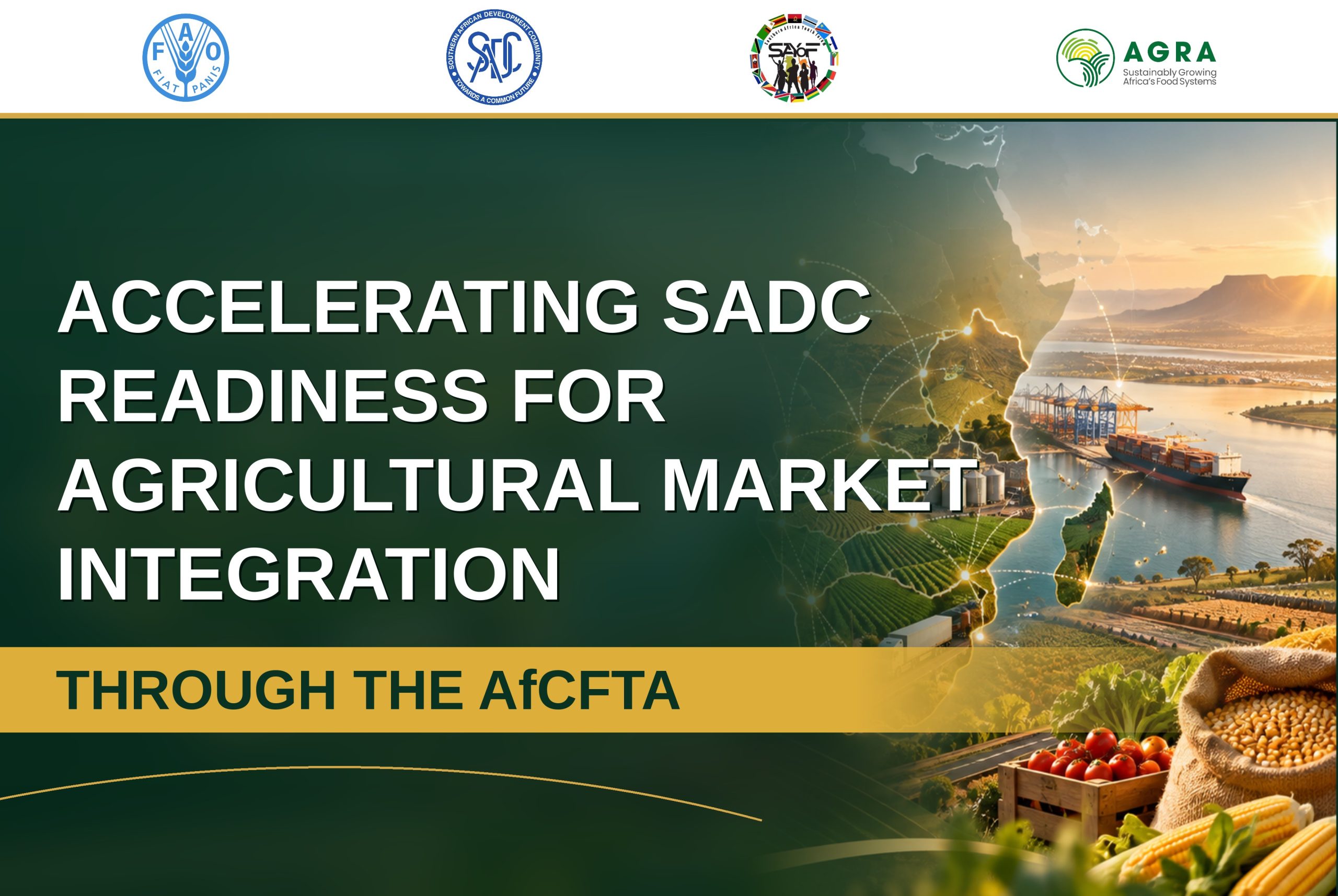
Held under the theme Accelerating SADC Readiness for Agricultural Market Integration through AfCFTA, the virtual meeting brought together policymakers, development partners, trade experts and youth agripreneurs from across the region to examine the opportunities the continental market offers and the barriers that continue to keep many young producers and traders on the sidelines.
Setting the agenda
Opening the session, Kudakwashe Watetepa, Youth in Agribusiness Expert at the SADC Secretariat’s Food, Agriculture and Natural Resources (FANR) Directorate, welcomed participants and outlined the webinar’s three objectives: improving understanding of the opportunities AfCFTA presents, discussing the barriers affecting agricultural trade in the region, and gathering recommendations to strengthen regional collaboration.
In his opening remarks, Mr Misheck Gondo, SAYoF’s Chief Executive Officer, underscored agriculture’s central role in the livelihoods and food security of millions across SADC. He warned that regional agricultural trade remains hampered by persistent non-tariff barriers and inconsistent standards between member states, challenges that fall hardest on young and small-scale operators with limited resources to navigate them.
Progress on paper, gaps in practice
Presenting FAO’s Gap and Barrier Analysis on AfCFTA implementation in SADC, Sydney Zharare of FAO noted that the continental agreement has come a long way since it was signed in Kigali in March 2018, entered into force in May 2019, and began preferential trading on 1 January 2021. Forty-nine of the African Union’s 54 member states have now ratified the agreement, 24 State Parties have completed domestication, and 48 tariff offers have been adopted targeting up to 97 percent of tariff lines. More than 92 percent of rules of origin tariff lines have been agreed, and National Implementation Committees have been established in 33 State Parties.
He also highlighted the Guided Trade Initiative, which has grown from seven to 39 participating countries and has seen more than 1,200 certificates of origin issued, as well as newer protocols on digital trade and on women and youth in trade adopted in 2024.
However, Zharare cautioned that implementation remains uneven. Tariff schedules are still incomplete, rules of origin negotiations for sectors such as textiles and automotive remain outstanding, non-tariff barriers persist, and many countries are struggling to move from national strategies to operational plans.
A system of interconnected constraints
The FAO analysis frames the challenge across three interdependent layers of the trade ecosystem. At the level of the core market system, smallholder farmers, aggregators, traders and buyers are held back by low productivity, rain-fed production, weak producer organisations, limited market linkages and poor compliance with sanitary and phytosanitary (SPS) and quality standards. Many farmers still depend on middlemen for price information, leaving them exposed to below-market farmgate prices.
Supporting functions such as transport, cold chain, digital systems, finance and insurance are unevenly developed. Zharare pointed to poor feeder roads, port inefficiencies and delays at busy border posts such as Beitbridge and Kasumbalesa, which can push transport costs above those of importing through global supply chains. National customs platforms are often not interconnected, agricultural trade is widely treated as high-risk by lenders, and index-based insurance remains confined largely to small donor-funded pilots. In the policy and regulatory sphere, slow domestication, overlapping membership of SADC, COMESA and the Tripartite Free Trade Area, separate national inspection regimes without mutual recognition, and weak enforcement of NTB resolution mechanisms all add cost and uncertainty for traders.
“Progress in one part of the system will not translate into trade unless the other parts function with it” was the central message of the analysis. Tariff liberalisation alone will not generate agricultural trade, and faster borders will have limited impact if products cannot be produced, aggregated and supplied consistently. SPS compliance, the presentation stressed, must begin at farm level and continue through handling, traceability, certification and transport.
Youth voices from the field
Youth representatives Thembela Msibi and Keatlegile brought the discussion down to the realities faced by young people trying to build agribusinesses. They described difficulties in accessing land, affordable finance and reliable market information, all of which limit their ability to scale up and compete regionally. They called on governments to move swiftly to implement the AfCFTA Protocol on Women and Youth in Trade so that its commitments translate into tangible support on the ground.
SADC Social and Human Development Youth Officer Memory Mhendera and Cuthbert Kambanje of FAO also contributed to the discussions, which emphasised meaningful youth participation in shaping and implementing regional trade policy.
Simplifying trade for small-scale traders
Mr. Rangarirai Machemedze, Project Coordinator of the Tripartite Simplified Trade Regime (STR) for COMESA, SADC and the EAC, outlined how simplified trade regimes can help small-scale cross-border traders access preferential treatment without the burden of complex customs procedures. The FAO analysis noted that such regimes are considerably less developed in SADC than in COMESA, pushing many small traders towards informal crossings where they lose out on AfCFTA benefits. Participants also explored the potential of digital solutions and agri-tech hubs to connect young producers to markets, information and services.
The way forward
FAO’s recommendations centre on moving beyond productivity support towards market-oriented development. Proposals include strengthening cooperatives, outgrower schemes and aggregation hubs; integrating grading, post-harvest handling and SPS compliance into extension services; localising market information systems; and aligning support with the Agri-Trade Action Plan for maize, legumes and horticulture. On supporting functions, the organisation proposes helping national plant protection organisations operationalise ePhyto, piloting investment in cold chain and storage, improving efficiency along the Beira, Nacala and North–South corridors, and expanding blended finance and insurance models. At the policy level, it calls for technical assistance on domestication, advancing mutual recognition agreements, stronger NTB resolution, and inclusive trade frameworks that bring informal traders into formal systems.
The analysis sets out a phased roadmap: quick wins on ePhyto, NTBs and targeted SPS investment within the first year; linking soft systems with hard infrastructure such as value chain clusters, agro-processing and cold chain integration over one to three years; and, in the longer term, integrated agro-industrial corridors, fully harmonised SPS systems and interoperable digital trade ecosystems across SADC. FAO positions its role not as launching new standalone programmes, but as a systems integrator embedding SPS, food safety and agricultural trade compliance into existing regional and continental initiatives.
Participants closed the webinar in agreement that AfCFTA’s institutional foundations are largely in place and that the task now is translation into practice. Only a systemic approach, connecting the full pathway from farm production to regional markets, will ensure that the continental market delivers real benefits for the region’s young farmers and entrepreneurs. #SAYNews: the voice of Youth in Southern Africa!