



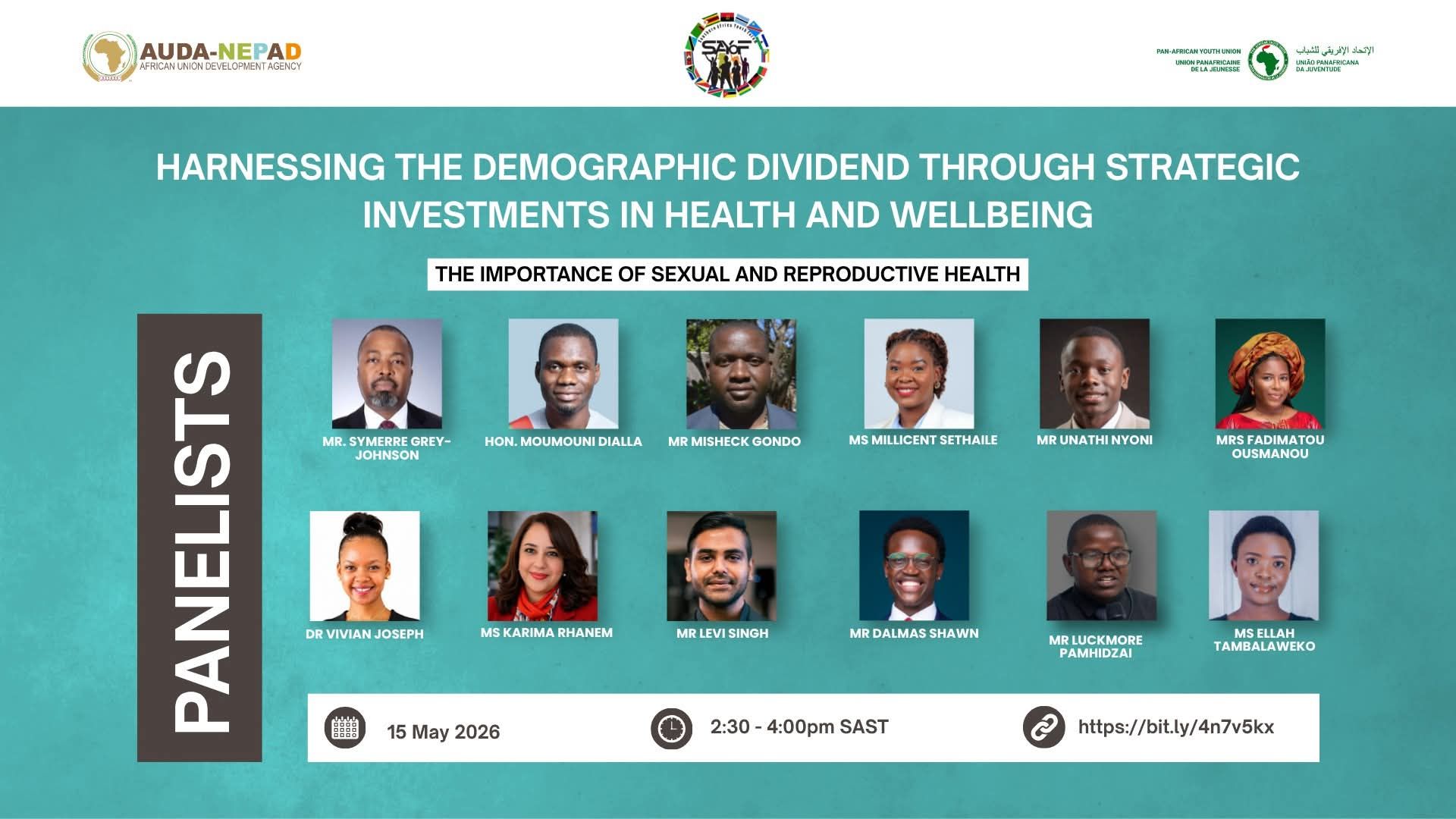
Southern Africa Youth Forum (SAYoF) Key Note Remarks on the Webinar convened by AUDA-NEPAD, Pan-African Youth Union, and Southern Africa Youth Forum (SAYoF), Pan-African Youth Union; Themed: “Harnessing Demographic Dividend: The Critical Role of Sexual and Reproductive Health.” Presentation made by SAYoF Chief Executive Officer, Mr Misheck Gondo.
SALUTATATIONS
AUDA-NEPAD Senior Advisor to the CEO, Mr Linton Mchunu, AUDA-NEPAD: Director Human Capital and Inst. Development: Mr. Symerre Grey-Johnson, President, Pan African Youth Union(PYU)Hon. Moumouni DIALLA, Ms. Juliana Tahina Ratovoson, Our Moderator: Ms. Asmae Boureddaya, Resident Representative, National Coordinator of SRH initiatives. Southern Africa Youth Forum (SAYoF) Board Co-Chairs, member institutions, distinguished partners, experts, Students, SRH Champions, and youth leaders, ladies and gentlemen, good afternoon!
On behalf of the Southern Africa Youth Forum (SAYoF), I would like to offer our warmest welcome to you all. We are honoured to be part of this important webinar convened under the theme “Harnessing Demographic Dividend: The Critical Role of Sexual and Reproductive Health.” This convening matters because it places young people’s health, agency, and future firmly at the centre of Africa’s development story and trajectory.
Today, we are not simply discussing Sexual and Reproductive Health—we are discussing the life trajectory of our continent. We are discussing whether young people can complete their education, transition into decent employment, build healthy families, participate fully in society, and contribute to inclusive economic growth.
Why we must talk about SRH to harness the demographic dividend!
Africa’s demographic profile is a strategic window of opportunity. But demographic dividend is not automatic; it depends on whether countries invest in people, systems, and governance to transform youth potential into productivity and well-being.
In this context, Sexual and Reproductive Health (SRH) is a critical lever for unlocking the demographic dividend. When SRH is prioritized, we reduce maternal mortality, prevent unintended pregnancies, improve outcomes for women and girls, and enable young people, especially adolescents and youth, to make informed decisions about their bodies and futures.
Conversely, when SRH remains underfunded or inaccessible, countries pay a heavy price: higher maternal mortality, increased school dropout due to pregnancy and gender-based barriers, poor health outcomes, and weakened prospects for decent work and economic participation. In short, SRH is not a standalone sector; it is directly linked to education, employment, health security, and long-term development gains.
So, the question before us today is clear: How do we ensure that SRH is integrated, resourced, and implemented—at the national level and at the continental level? And crucially, where do youth leaders and youth voices sit in the process?
However, Youth leadership and continental mobilisation: not optional-essential.
SAYoF firmly believes that youth leadership is not only a right; it is a requirement for effective SRH outcomes. Youth are often the most affected by gaps in SRH information, services, and accountability mechanisms. Yet too often, young people remain “beneficiaries” rather than co-designers of policy, programming, and implementation.
If we are serious about harnessing the demographic dividend, we must ensure:
- Meaningful youth participation in SRH policy and planning, beyond consultations, into decision-making and oversight.
- Access to youth-friendly SRH services, including comprehensive sexuality education, confidential and non-judgemental counselling, and services that respect dignity, privacy, and informed choice.
- Policy advocacy led by youth, anchored in evidence, human rights, and community realities.
- Accountability systems that track delivery, so that commitments translate into services on the ground.
Distinguished participants, allow me to briefly highlight some of the work SAYoF has supported, particularly in the Southern African context, where youth leadership and parliamentary engagement have proven to be powerful pathways for change.
1) SAYoF MOU with SADC-PF and strengthening parliament–youth engagement
SAYoF has a Memorandum of Understanding (MOU) with the SADC Parliamentary Forum (SADC-PF). Through this collaboration, we work to strengthen the link between SRHR evidence, youth voices, and legislative action, recognising that sustainable SRH outcomes require strong policy environments and responsive governance.
2) Work with 16-member parliaments on SRHR
A key part of our engagement has been supporting work with 16 member parliaments on Sexual and Reproductive Health and Rights (SRHR), and we started with Malawi, Zambia, and Zimbabwe. This is important because parliaments shape budgets, oversight, laws, and accountability structures, making them essential partners in ensuring SRH is integrated into development frameworks.
3) SRH training by SAYoF and HIVOS for over 70 parliamentarians.
Through collaboration with HIVOS, SAYoF supported SRH training for over 70 parliamentarians from 16 SADC countries during the SADC-PF Joint Standing Committee Meetings IN 2025. This training has helped strengthen parliamentarians’ understanding of SRH priorities, the policy and legislative measures needed, and the practical steps that can improve access to youth-friendly services.
4) Selection of SRH Parliamentary Champions via #Concent2Access
Finally, through the #Concent2Access program, we supported the identification and selection of SRH Parliamentary Champions from Malawi, Zambia, and Zimbabwe, and moving to the other 13 remaining countries, and we are calling for collaboration to finish this work. This milestone reflects a growing recognition that SRH advocacy must be championed from within legislative institutions, so that progress can be sustained through oversight, reform, and resourcing.
As we move from discussion to action, we urge all stakeholders, institutional partners, civil society, development actors, and youth networks to strengthen the integration of SRH into both national development plans and continental frameworks.
From our perspective, practical recommendations include:
- Institutionalise youth-friendly SRH service delivery within health system strengthening, including clear service standards, confidentiality protections, and community-linked outreach.
- Invest in comprehensive sexuality education and evidence-based SRH information so young people can make informed choices before crises occur.
- Strengthen youth participation in accountability mechanisms, including monitoring of SRH indicators, service availability, and budget tracking.
- Align SRH with education and employment outcomes; for example, linking SRH support to school retention strategies and pathways for youth wellbeing and productive engagement.
- Empower parliamentarians and local governance structures to translate SRH commitments into laws, budgets, and oversight.
- Ensure continuity of financing, because the demographic dividend requires sustained investments, not one-off interventions.
Closing remarks
Honourable colleagues, friends, and youth leaders, Africa’s demographic profile offers a strategic window for transformation. But that transformation depends on whether we invest in health and wellbeing, and specifically whether we treat SRH as a central part of development planning. SRH is critical to the demographic dividend because it advances wellbeing, strengthens education outcomes, enables healthier transitions into adulthood, supports youth employment potential by reducing barriers, and builds resilient and equitable societies.
SAYoF is ready to continue mobilising youth voices, strengthening partnerships with parliaments and institutions, and supporting youth-led advocacy priorities that ensure SRH services are accessible, inclusive, and accountable.
We thank AUDA-NEPAD, PYU, and our partners for convening this platform. We are also grateful to our speakers and participants for sharing experiences, best practices, and solutions.
With that, I thank you, and we look forward to a meaningful discussion that results in practical commitments to move SRH from policy to measurable impact.
Thank you.