



WELCOME ADDRESS BY THE SECRETARY GENERAL DURING THE JOINT SESSION OF STANDING COMMITTEES
ENHANCING PARLIAMENTARY ADVOCACY FOR THE EFFECTIVE DOMESTICATION AND IMPLEMENTATION OF SADC PROTOCOLS FOR DEMOCRATIC AND INCLUSIVE GOVERNANCE
19TH MAY 2026
Our guest of honour Dr Kevin Casablanca- Zamora, Secretary General of International IDEA; a legend beyond measure;
Deputy Speaker Hon Hellen Manyeneng Deputy Speaker of Parliament of Botswana;
Hon. Members, in your respective hierarchies back at your parliaments and here at the Forum;
Our Partners as already mentioned
Karibuni Waheshimiwa Wabunge of the United Republic of Tanzania;
SADC citizens online;
Let me also welcome Seychelles our hosts for the 59th Plenary Assembly Session;
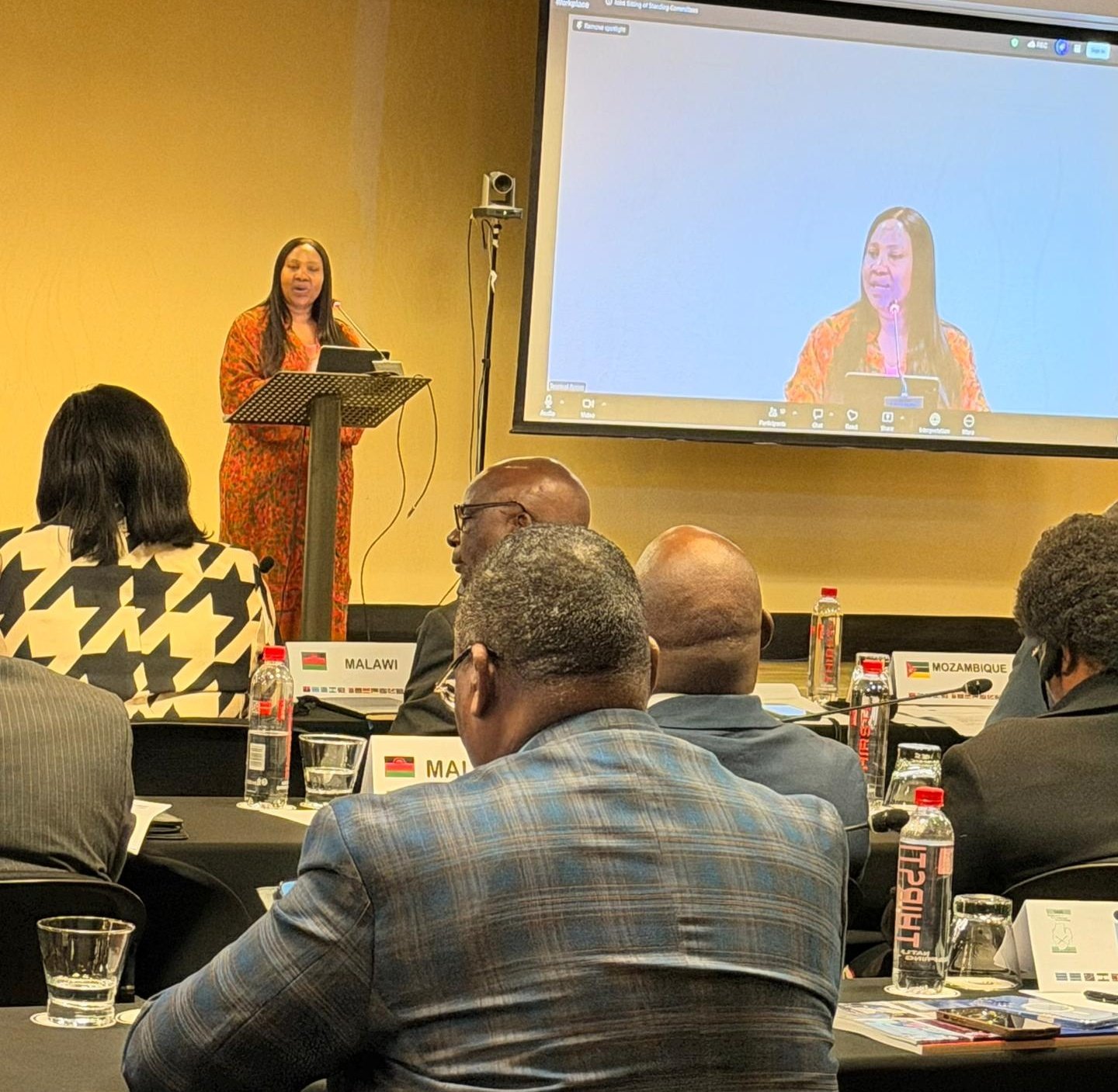
It is with the greatest humility and honor, that, I welcome you to this august Joint Session in my capacity as your anchor to the Secretariat, as we come together to canvass how we can enhance parliamentary advocacy for the effective domestication of SADC Protocols for democratic and inclusive Governance.
As you are aware, the SADC Parliamentary Forum highly values inter-parliamentary cooperation between its 15 Member parliaments. In addition, the Forum values the fostering of cross-linkages between standing committees given that topics such as parliamentary engagement and democracy intersects with several thematic areas and thus cannot be viewed in silos.
We welcome you to Johannesburg and in particular to this Joint Session of Standing Committees to examine parliamentary engagement and democracy from a kaleidoscopic lens and perspectives which this joint audience bestows us in terms of geographical diversity and balanced views.
As you are well aware, parliamentary democracy globally is being threatened to erode in 2026. In some countries, the representation of women is stifled at the stake of partisan politics, with patriarchal leaderships. Instead of being valued and integrated, women representation threatens to be altogether eroded, even eliminated. SADC National Parliaments struggle to attain the 50% gender parity envisaged by the SADC Protocol on Gender and Development.
At the same time, inequalities strive to be addressed in a timely manner. Political parties do not generally encourage inclusion of disabilities and the youth, which reflects poorly on their corresponding representation in Parliament. Despite attempts to eliminate the communication gap with Parliament, CSOs are still considered as outsiders to parliamentary action when in fact they should be integrated into initiatives within an inclusive partnership framework.
All these challenges gravitate around inclusiveness in engaging parliament as an institution.
Without inclusiveness, a parliament can fail its people.
Without inclusiveness, those who deserve to be adequately represented will end up being left out on the sidelines of policy initiatives, with parliament responding to popularity rather than the call of its people.
Today and tomorrow, we aim to advance inclusivity through parliaments by deliberating on the 4 tracks as outlined, with MPs deliberating on women participation in political life, the advancement of disability, youth, and CSO participation, as well as the advancement of anti-sexual harassment policy and the protection of Prisoners through the Model Law.
You will observe that during this joint session, much emphasis is placed on the protection of vulnerable groups, be it disabled persons, vulnerable women, or key populations including prisoners, particularly because Parliament legislates to protect those who are devoid of power, even as it protects all citizens under the principle of equality of the law. This aspect reflects the Strategic Plan (2024-2028) of the SADC-PF where the Forum stands to proudly represent all citizens in the region, leaving no one behind.
During this Joint Session, 2 normative instruments will be considered. The first is the principles relating to the anti- sexual harassment policy of the SADC-PF. The objective undergirding the policy is that by benchmarking on the progress made by the Inter-Parliamentary Union in the field of anti- sexual harassment, all representatives who have taken Oath and pledged to respect and uphold the Rules and Constitution of the Forum should indeed be adequately respected and protected. Deviant behaviour should as far as possible be dealt with not only by the law of the land where the occurrence takes place, but also by the Forum through disciplinary measures. To ensure the widest acceptance of the Policy, it will be tabled to this august Joint Session for your inputs and contributions.
Additionally, the long-awaited SADC Model Law on Prison Oversight will be examined a final time for drafting consistency before being recommended to the Plenary Assembly for adoption. MPs who have been at the Forum for the last 2 years will recognise the importance of this landmark step in the life of this Model Law. In 2026, individuals have perished under prison control in the SADC region, due to brutality or other reasons, leaving families in utter turmoil and despair. Prison life has become a double sentence for many offenders, because they need to expunge their court ordered sentences, and another extrajudicial sentence which the circumstances have chosen for them, leading to illnesses, torture and often death. It is confronted with these challenges that the Forum intends that the SADC Model law on Prison Oversight brings fresh perspective to policy-making and places parliament at the centre of accountability mechanisms. The Model Law also aims to assist with the re-integration of ex prisoners and detainees who have served their sentence to the community. Citizens should not be punished once by the Court, a second time by the harsh conditions of jail, and a third time by barriers to obtain employment. Prison time should not become a fatality akin to a death sentence. Indeed, Forum policy is to the effect that citizens must be able to re-integrate socio-economic life after having duly purged their judicial sentence.
While the Model Law will constitute the latest addition to the Bill of Rights of the Forum, other Model Laws reinforce it such as the Model Law on HIV and the Model Law on GBV to provide a comprehensive protection to inmates.
Honourable Members, distinguished colleagues and participants.
We meet during this Joint Session because we believe in parliamentary support and the engagement of parliaments to advance thematic initiatives.
Your wisdom today and tomorrow matters. We expect interaction and informed recommendations to be subsequently made to the Plenary Assembly of the Forum.
As part of ensuring that the Forum gets to hear from the cream dela cream of experts in Democratic governance, the Secretary General of International IDEA, whose experience in this areas spans over 30years was kind enough to grace this Joint Session, a legend in his own right and an erudite political scholar, who is unmatched with regards to unpacking the state of Democracy globally. He will inspire you.
For the record, The Forum fully recognises the inherent role espoused by International IDEA in election observation and electoral assistance in Southern Africa.for the 2026, activity plan, International IDEA and the Forum are poised to consider in detail joint collaborative endeavours in domesticating the SADC Model Law on Elections, a key instrument for benchmarking election norms in the region and even beyond, and the SADC Model Law on Constitutionalism and the rule of Law for comparative peer learning focusing on reimagining democracy and governance, as commemorated during its 30th Anniversary.
Let us continue to make history during this Joint Session in fostering parliamentary engagement and democracy for a more inclusive society.
It is only together that we can advance with certainty and momentum.
On this note, I wish you a pleasant Joint Session.
Thank you.
Ms B.Sekgoma,
Secretary General
19th May 2026