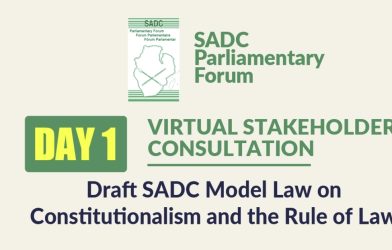



SADC Parliamentary Forum (SADC-PF) will hold a Stakeholder Consultation on the SADC Model Law on Constitutionalism and the Rule of Law (SMLCRL) from 16 June to 25 June 2026, as part of an ongoing effort to strengthen constitutional frameworks across the Southern African Development Community (SADC). The consultation comes as the Forum continues drafting the proposed Model Law, which is expected to provide practical guidance for improving constitutional compliance and institutional functioning throughout the region.
The SMLCR is designed to establish a coherent normative framework rooted in core SADC democratic instruments, including the SADC Treaty, the African Charter on Democracy, Elections and Governance (ACDEG), and relevant SADC Parliamentary Forum instruments. In doing so, the Model Law is intended to reinforce foundational democratic principles such as the rule of law, separation of powers, accountability, and constitutional supremacy. The Model Law will act as a comparative reference tool, illustrating how harmonised soft-law approaches can help set shared standards for due process, legal certainty, and democratic governance across SADC member states.
The Forum also aims to empower constitutional actors by equipping legislatures, executives, judiciaries, oversight institutions, and independent oversight commissions with a common reference framework. This, according to the Forum, is meant to support stronger constitutionalism and improve how institutions carry out their mandates. The Model Law is further expected to clarify how different branches of government should operate within constitutional limits, including how they should collaborate to protect rights, uphold checks and balances, and maintain accountability within a broader constitutional order.
A key focus of the proposed SMLCRL is governance crisis response mechanisms. Drawing on regional experience and the ACDEG principle of preventing unconstitutional changes of government, the consultation is expected to refine structured guidance for restoring constitutional order during periods of political and institutional instability. This includes situations where democratic rule is interrupted or where institutional functioning breaks down, with the Model Law positioned as a structured framework for guiding constitutional recovery.
Unlike treaties or formal declarations, Model Laws are non-binding soft-law instruments. Their influence, organisers say, lies in their adaptability and their ability to inspire legal reform while promoting convergence on shared democratic values across jurisdictions.
The drafting process began in April 2026, following the Forum’s engagement of a legal drafter and a preliminary in-person stakeholder meeting held in Johannesburg, South Africa. Throughout the drafting phase, the current stakeholder consultations are being conducted virtually to capture real-time inputs from relevant actors. The Forum says this approach is intended to ensure the draft reflects regional realities and incorporates the lived experiences of sectors with direct governance, legal, and democratic mandates.
To guide the consultations, the Forum will use a methodology that combines structured presentations and facilitated participation. Each virtual session will open with an overview of the SMLCRL development roadmap and objectives, followed by a detailed presentation of the current draft by the Legal Drafter. A participatory dialogue will then allow stakeholders to engage with the text in real time, submit thematic recommendations and technical input, and share national and institutional experiences relevant to constitutionalism and the rule of law.
The sessions will be held via Zoom and will be simultaneously interpreted in English, French, and Portuguese to encourage inclusive access and participation across the region.
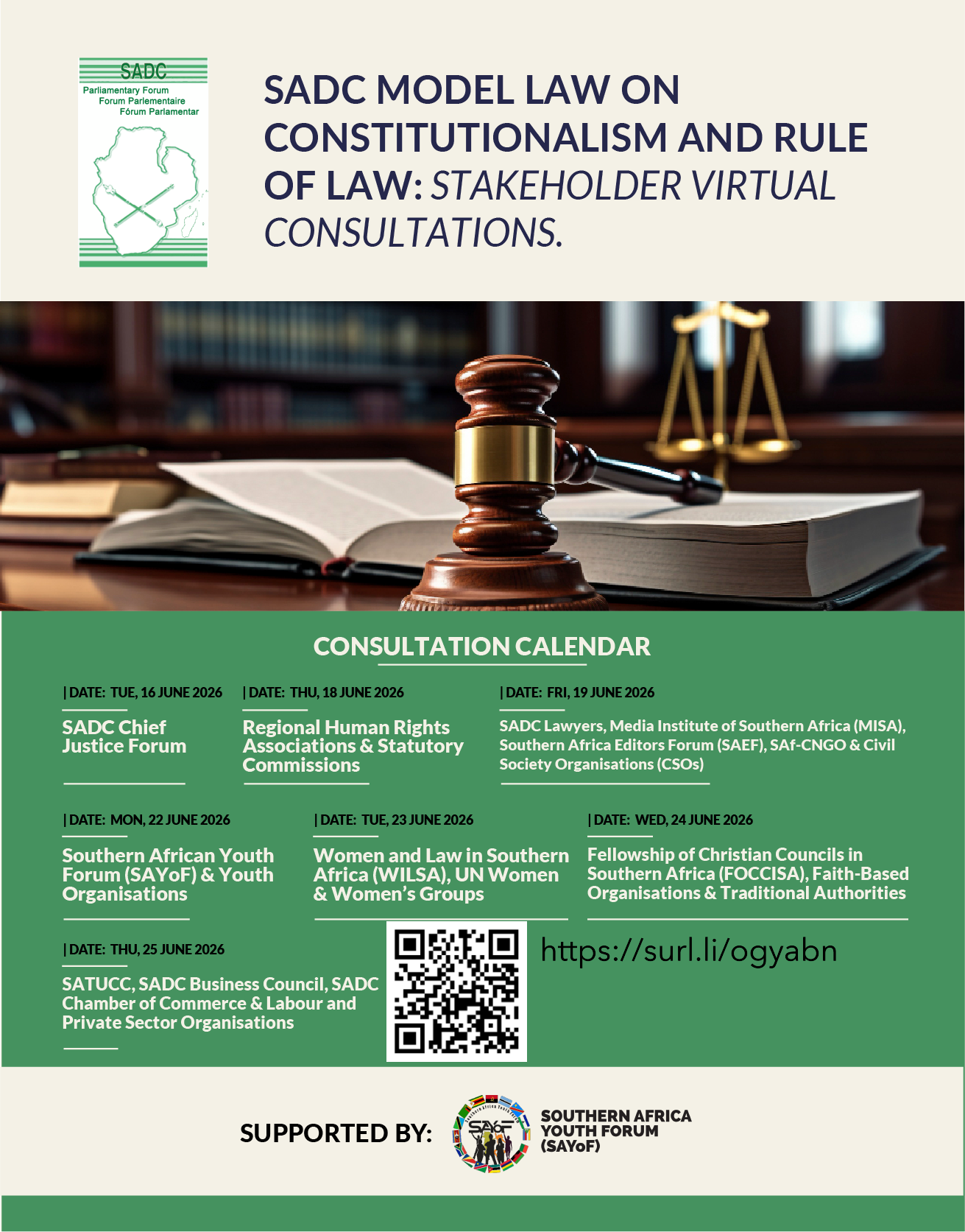
Stakeholders are being consulted in a phased, sector-specific manner between 16 and 25 June 2026. On 16 June, the consultation will involve the SADC Chief Justice Forum. On 17 June, stakeholders will include Electoral Commissions Forum (ECF–SADC) partners and Electoral Management Bodies (EMBs). On 18 June, discussions will focus on Regional Human Rights Associations and Statutory Commissions. On 19 June, engagement will extend to SADC lawyers, the Media Institute of Southern Africa (MISA), the Southern Africa Editors Forum (SAEF), SAf-CNGO, and civil society organisations (CSOs).
Further consultations will be held on 22 June with the Southern African Youth Forum (SAYoF) and youth organisations, on 23 June with Women and Law in Southern Africa (WILSA), UN Women, and women’s groups, and on 24 June with the Fellowship of Christian Councils in Southern Africa (FOCCISA), faith-based organisations, and traditional authorities. The consultation will conclude on 25 June with SATUCC, the SADC Business Council, the SADC Chamber of Commerce and Labour, and private sector organisations.
These engagements reflect the Forum’s commitment to participatory law-making and broad regional ownership, as SADC-PF seeks to refine the SMLCRL through transparent, inclusive consultation before it advances further in the law-drafting process.