




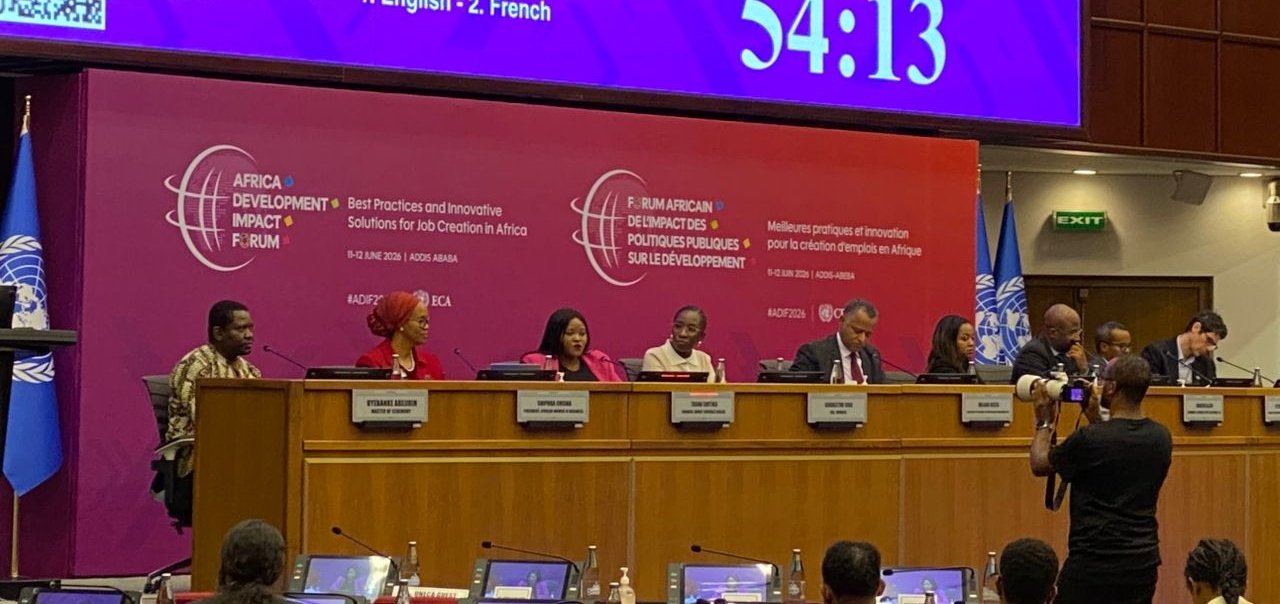
On Thursday, 11 June 2026, an ADIF Action-Oriented Engagement Session titled “Unlocking Regional Value Chains: Empowering Youth-Led Enterprises in Africa to Thrive Under AfCFTA” brought together development stakeholders, policymakers, and youth entrepreneurs in Addis Ababa, Ethiopia. The session was organized by the ECA Subregional Office for Southern Africa (SRO-SA) in collaboration with the ECA Regional Integration and Trade Division, the International Labour Organization (ILO), and the Southern Africa Youth Forum (SAYoF). The session was held during the Africa Development Impact Forum currently underway at the UN Conference Centre in Addis Ababa.
Moderating the session was Melaku Desta, Director, ECA Regional Integration and Trade Division (RTID). The discussion featured entrepreneurs and subject-matter experts, including Tasha Chitika (Founder, Young Generals Dealer, Zambia), Gugulethu Siso (Founder, Tumziwe Zimbabwe), and Semhal Guesh Berhe (Founder, Kabana). The entrepreneurship segment also included the voice of Shemhal Guesh Berhe, alongside the other entrepreneurs on the panel.
In the speakers’ segment, the forum also included representatives focused on policy, market development, and youth enterprise support. These included Shiphria Chisha, Director of Programmes, GRCMS and SADC Business Council; Fetene Aragaw, Business Development Manager, ADeTrode; Andrew Allieu, Regional Economist at the ILO; Emmanuel Soubiran, Policy and Programme Officer (EU Delegation to AU and ECA). Mishek Gondo, Chief Executive Officer of the Southern Africa Youth Forum, and Eunice G. Kamwendo, Director, ECA Subregional Office for Southern Africa, gave closing remarks
The session structure reflected ADIF’s implementation-first approach: it combined entrepreneur testimonies with roundtable dialogue and short Q&A to move from identifying barriers to shaping actionable solutions. Speakers used the forum to address a shared development concern—despite Africa’s large youth population, unemployment and underemployment remain persistently high. Speakers linked this to structural weaknesses that limit youth enterprise growth, including limited value addition, weak industrial capacity, fragmented markets, skills mismatches, and restricted access to finance. Within this context, the session emphasized that while the AfCFTA is expected to expand trade opportunities by reducing tariffs and harmonizing trade rules, youth-led businesses often struggle to participate due to financing gaps, compliance costs, weak market linkages, and trade facilitation barriers.
In that regard, the session highlighted four interrelated themes. First, the session underscored that access to finance remains a major bottleneck for youth-led SMEs, especially for trade finance, credit guarantees, and early-stage capital. Second, it examined how market access is constrained by limited supply-chain integration, weak market information systems, and the cost of meeting standards required for regional and export markets. Third, it drew attention to how trade facilitation and digital borders—including cumbersome procedures, high logistics costs, limited cross-border payment systems, and gaps in digital infrastructure—continue to raise the cost and complexity of intra-African trade. Finally, the session explored how leveraging technology and e-commerce could help youth enterprises convert digital presence into real, cross-border commercial activity under AfCFTA.
Overall, the session aimed to generate practical outcomes and commitments for implementation. Organizers stated that the goal was to identify actionable reforms and enablers—spanning policy alignment, innovative and targeted financing approaches, improved standards and certification support, stronger value-chain linkages, digital trade infrastructure, and multi-stakeholder partnerships—so youth-led enterprises can move from survival entrepreneurship to competitive participation in regional value chains.