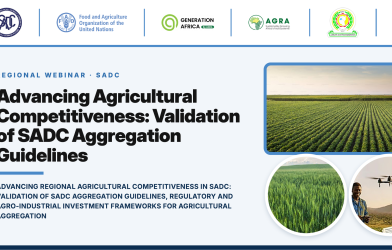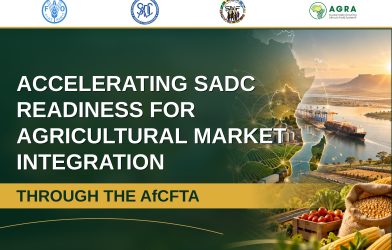




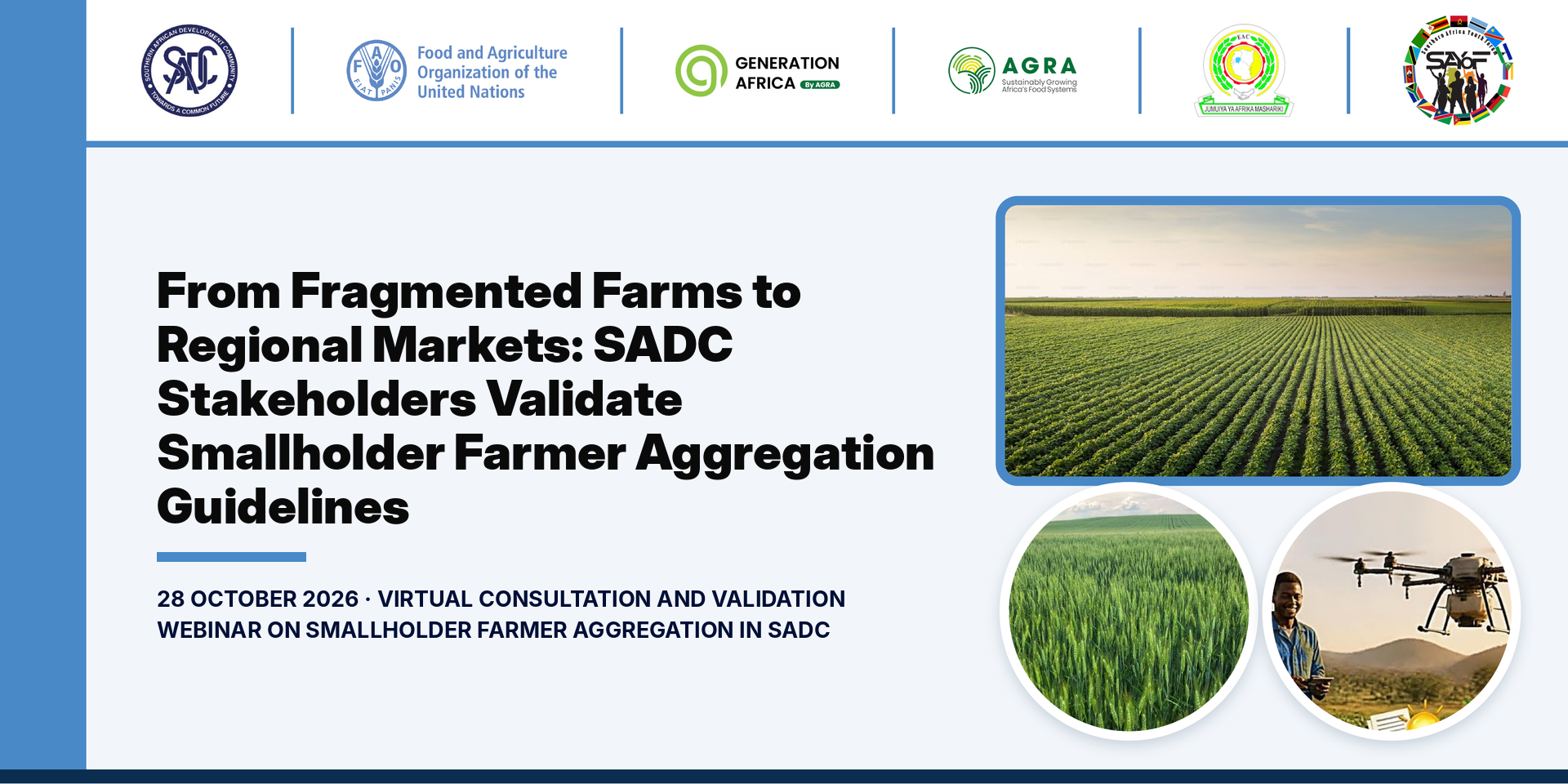
28 October 2026, Virtual: Smallholder farmers across Southern Africa moved a step closer to stronger market power on 28 October 2026, when stakeholders from across the region met online to validate the draft SADC Guidelines and Regulatory Frameworks for Smallholder Farmer Aggregation and Rural Agro-Industrial Investment Plans.
The two-hour webinar was convened by the Food and Agriculture Organization of the United Nations (FAO) Subregional Office for Southern Africa under its STOSAR II project supported by the European Union, in collaboration with Generation Africa, the Southern Africa Youth Forum (SAYoF), the SADC Secretariat, AGRA and the East African Community (EAC). Held under the theme “Strengthening inclusive market participation for smallholder farmers, youth and fostering investment for sustainable agricultural transformation and trade integration.”
The meeting comes at a time when Africa’s agricultural sector, worth about US$280 billion a year and projected to reach US$1 trillion by 2030, still leaves the continent spending between US$70 billion and US$100 billion annually on food imports. Organisers said the root of the problem for many SADC countries is scale: smallholder farmers produce small, scattered volumes, have weak bargaining power and struggle to meet buyers’ quality and regulatory standards. Aggregation, in which farmers organise to produce, store and sell together, was presented as one of the most practical answers, and young people were given a central role in the discussion rather than being treated as an audience.
The programme opened with a welcome from Mr. Kuda Watetepa of the SADC Secretariat and Mr. Gondo, Chief Executive Officer of SAYoF, followed by opening remarks from Mr. Peter Byemaro Kazungu, STOSAR II Agribusiness and Food Systems Specialist. The main presentation was delivered by Ms. Lindani Maphosa, FAO’s Smallholder Market Development and Aggregation Specialist, an agricultural consultant, university lecturer and published researcher with more than 19 years’ experience in food security, climate resilience and agricultural market development. Ms. Thembela Msibi (SAYoF Board Member) moderated the session and led a panel discussion on commodity aggregation for inclusive value chain development, focusing on expanding market opportunities for women, youth and smallholder farmers in SADC. Two youth leaders from SADC and EAC regions, Mr Blessings Mlelemba and Ms Regina Mkanda, made presentations in response to the presentation; young people and stakeholders were given time to make contributions and review the guidelines. Mr. Jarc Tusiime, Director of the East Africa Youth Network, delivered the closing remarks.
Presenting the draft guidelines, Ms. Maphosa explained that they were developed from a review of SADC’s Regional Agricultural Policy, the Regional Indicative Strategic Development Plan (RISDP) 2020–2030 and the SADC Industrialization Strategy, together with consultations with stakeholders in Member States. She noted that no single model fits all contexts, and that the right arrangement depends on the commodity, market requirements, farmers’ needs, institutional capacity and risks involved.
The guidelines describe ten aggregation arrangements, ranging from producer-owned cooperatives, commodity associations and contract farming schemes to hub-and-spoke clusters, warehouse receipt systems, farmer-owned companies and public–private partnerships, and match each to suitable value chains. Grains and oilseeds, for instance, are suited to cooperatives and warehouse receipt systems, horticulture to hub-and-spoke and exporter-led models, and dairy to milk collection centres.
Ms. Maphosa stressed that successful aggregation must begin with real buyer demand and commercial commitment before production starts. She said elected farmer leadership builds trust and ownership, but complex commercial operations also require skilled professional managers. Farmers, she added, must participate in planning and decision-making and receive timely information on prices, grading, deductions, and payments. Production capacity should be strengthened before major infrastructure is built, and facilities should be sized to realistic volumes. Aggregation entities are expected to grow step by step from nascent to emerging, established and finally investment-ready, with support matched to their demonstrated readiness.
The framework also contains model regulatory provisions that Member States can adapt to their national laws. These cover the registration of aggregation entities, protection of farmers’ produce, funds and assets, fair contracts and payment safeguards, quality and sanitary and phytosanitary (SPS) compliance, data governance, and complaints and appeals mechanisms.
To show that aggregation can be commercially viable, Ms. Maphosa presented three costed investment cases. A horticulture hub-and-spoke model for vegetables, linking 500 contracted farmers to a central packhouse and cold chain, requires US$2.37 million and is projected to market 5,200 tonnes a year by its fifth year, with an internal rate of return of 10.3 percent and payback in about five years. A processor-led broiler out-grower scheme involving 250 farmers and a central hub processing 8,000 to 10,000 birds a day requires US$2.65 million. The largest, a warehouse receipt system for grains built around a 10,000-tonne certified warehouse and electronic warehouse receipts, requires US$9.35 million and is projected to handle up to 145,000 tonnes a year by year five, with an internal rate of return of 30 to 35 percent and payback in three to three and a half years.
Participants were asked whether the guidelines address the region’s real aggregation challenges, whether any models are missing, and whether the requirements are practical for entities at different levels of maturity. Their feedback will inform the final version of the guidelines and investment plans before implementation begins.
Under the proposed implementation pathway, Member States will assess the guidelines against national laws, identify priority value chains, develop national implementation plans, and pilot the approach through existing programmes before scaling up what works. The SADC Secretariat will coordinate regional rollout, peer learning, and periodic review, while aggregation entities will apply the guidelines in their daily operations, supported by practical toolkits on governance, buyer contracts, investment readiness, and SPS compliance.
For the region’s young farmers and agripreneurs, the webinar’s message was clear: organised, market-led, and well-governed aggregation can turn small farms into a serious force in regional trade, and youth are expected to help lead that change.